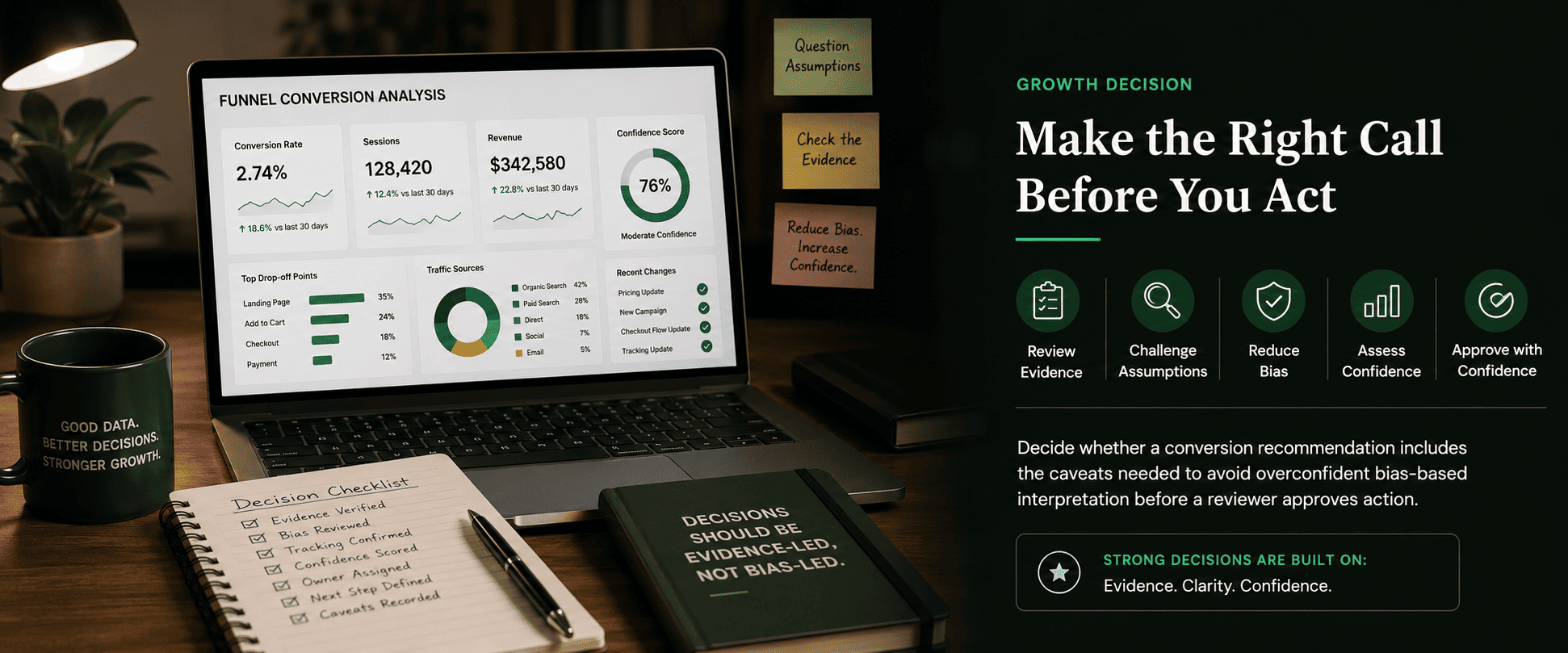
Cognitive Bias Decision Caveats Checklist for Funnel Conversion Analysis
Conversion teams often make decisions under pressure. A funnel drop appears in GA4, a heatmap looks unusual, a session recording shows visible friction, or a stakeholder sees one campaign result and asks for immediate action. The pattern may be real, but the interpretation can still be biased. A cognitive bias decision caveats checklist helps the team slow the recommendation down enough to separate evidence from assumption before changing a page, offer, funnel, or experiment.
The goal is not to block useful CRO work. The goal is to make sure the recommendation has the right caveats, evidence, owner, and approval status before implementation. In funnel conversion analysis, this matters because a decision can look obvious while still being incomplete. A lower conversion rate may be caused by message friction, but it may also come from a traffic-quality change, attribution issue, tracking delay, mobile mix shift, seasonality, or downstream revenue problem.
This checklist gives conversion leads, growth teams, and analysts a structured way to ask: should this recommendation be approved, held, or sent back for evidence?
Why Bias Shows Up in Funnel Decisions
Funnel analysis naturally invites interpretation. Analysts see movement in conversion rates, stakeholders compare performance to targets, and teams look for the fastest fix. Bias enters when the team treats a visible signal as a complete explanation before testing the evidence behind it.
For example, a landing page may look weak because users do not click the CTA. But the real issue may be that the campaign promise does not match the page, the audience is colder than expected, or the buyer has not been given enough proof, process clarity, or price reassurance. Changing the CTA without reviewing the full path may only make the decision feel productive while leaving the real conversion gap untouched.
- Confirmation bias: The team sees data that supports an existing belief and ignores conflicting evidence.
- Recency bias: A recent campaign, complaint, or test result feels more important than the broader trend.
- Anchoring bias: An old benchmark shapes the decision even though the offer, price, or traffic mix changed.
- Availability bias: A few vivid session recordings feel representative without enough funnel evidence.
- Authority bias: A senior opinion moves the recommendation forward before the caveats are reviewed.
What the Checklist Should Force Before Action
A cognitive bias decision caveats checklist should force the reviewer to name the evidence, hold condition, owner, and approval state. The team should not move straight from “we noticed a pattern” to “change the page.” The checklist should show what is observed, what is assumed, what would weaken the interpretation, and what must stay on hold if approval is not granted.
- Observed input: What did the team actually see in GA4, heatmaps, recordings, tests, or dashboards?
- Assumption: What explanation is the team attaching to that observation?
- Caveat: What could make that explanation weaker or incomplete?
- Evidence source: Which report, recording, test summary, or downstream system supports the claim?
- Approval gate: Who must accept the recommendation before the page, offer, or experiment changes?
- Hold condition: What stays paused if the evidence is not strong enough?
Core Review Areas
A conversion recommendation should not rely only on source movement or front-end events. The reviewer should connect campaign or funnel movement with commerce and payment context before judging quality. If conversion volume rises but order quality, cash timing, margin, or downstream value is unclear, the recommendation should remain caveated.
Many funnel issues are not caused by traffic volume. They come from weak belief. The page may ask for action before the buyer understands the promise, problem, proof, process, price concern, or next step. If the buyer has not been given enough emotional and logical support, adding more traffic can scale confusion instead of improving conversions.
The checklist should separate decision-driving conversions from diagnostic events. A button click, scroll, video view, or form start may be useful, but it does not always prove business impact. The reviewer should confirm whether the tracked event connects to a downstream quality source such as CRM status, sales outcome, payment record, or product usage.
Before treating a scenario as decision evidence, the team should separate observed inputs from assumed numbers. A small change in conversion rate, average order value, close rate, or payback window can make a recommendation look stronger than it really is. If the model is sensitive to an assumed number, the recommendation should stay as a scenario until the source is verified.
Bias-aware copy recommendations often change framing. That can be useful, but the reviewer must confirm that the new frame changes emphasis without changing the underlying claim, offer, price, or risk disclosure. If the new version hides risk, overstates proof, or changes the offer, the recommendation should be held.
- Check product performance and order quality.
- Review payment signal and cash timing.
- Compare conversion movement with revenue quality.
- Hold the recommendation when payment or margin context is missing.
- Does the page clearly state the promise?
- Does it explain the buyer’s problem and pain?
- Does it provide enough proof before the CTA?
- Does it reduce price, effort, or risk concerns?
- Does the CTA make the next step clear?
- Separate diagnostic events from actual conversion actions.
Approval Questions Before a Funnel Change
Before approving a page, offer, or experiment change, the reviewer should answer a focused set of questions. These questions help prevent bias-based recommendations from moving forward without enough evidence.
- Does the observed funnel issue appear across enough data to support action?
- Do GA4 reports, heatmaps, session recordings, and test summaries agree?
- Has tracking integrity been reviewed?
- Does downstream revenue or CRM quality support the interpretation?
- What evidence would weaken or reverse the recommendation?
- Has the caveat been written clearly enough for the reviewer?
- Is there an owner for the next action?
- Is there a rollback, retest, or hold note if the recommendation is not approved?
Example Review
A conversion lead sees lower performance on a product landing page and assumes the page needs stronger urgency messaging. The first recommendation is to add scarcity cues, stronger social proof, and a more aggressive CTA. Before approval, the checklist review compares the recommendation with funnel evidence.
The decision should not be immediate implementation. A stronger next step would be to hold the urgency recommendation, clarify price and process concerns, review traffic quality, and retest the message with the caveat visible. This protects the team from using bias-aware tactics in a way that adds manipulation risk instead of solving the buyer’s actual decision problem.
- GA4 shows conversion rate declined, but only for one traffic source.
- Heatmaps show users still reaching the proof section.
- Session recordings show confusion around pricing, not urgency.
- CRM quality from recent leads is lower than normal.
- The proposed urgency frame may change the perceived risk of the offer.
Final Takeaway
A cognitive bias decision caveats checklist improves funnel conversion analysis by forcing evidence review before action. It helps the team validate what is happening, name what is uncertain, and prevent overconfident recommendations from moving into implementation too early.
The best checklist does not remove judgment from CRO work. It improves judgment by requiring visible evidence, clear caveats, owner approval, and hold conditions. When the recommendation is supported, the team can act with more confidence. When the evidence is incomplete, the team can pause, revise, or retest before changing the page, offer, or experiment.
Commerce and revenue quality
Evidence to review: Product performance, order quality, payment signal, cash timing, and margin or payback caveat.
- Connect campaign or funnel movement with commerce and payment context before judging quality.
- If revenue quality or cash timing is missing, avoid turning source movement into a payback conclusion.
- Commerce and revenue quality is supported by visible inputs and the caveat is clear.
Message friction and belief gaps
Evidence to review: Promise, problem, pain, proof, process, price or effort concern, objection coverage, and call-to-action clarity.
- Review whether the page builds enough emotional and logical belief before it asks for action.
- If the buyer has not been given enough proof, process, or next-step clarity, do not recommend more traffic as the first fix.
- Message friction and belief gaps is supported by visible inputs and the caveat is clear.
Conversion quality and measurement confidence
Evidence to review: Conversion action, diagnostic event, downstream quality source, attribution caveat, and value signal.
- Separate decision-driving conversions from diagnostic events and caveated attribution signals.
- If conversion quality is unknown, keep the recommendation caveated until the downstream source is reviewed.
- Conversion quality and measurement confidence is supported by visible inputs and the caveat is clear.
Funnel math and scenario quality
Evidence to review: Traffic unit, stage conversion, offer value, expansion path, revenue timing, and confidence label.
- Separate observed inputs from assumptions before treating a scenario as decision evidence.
- If the model is sensitive to an assumed number, keep the recommendation as a scenario until the source is verified.
- Funnel math and scenario quality is supported by visible inputs and the caveat is clear.
Frame equivalence caveat
Evidence to review: Current message, proposed message, unchanged facts, buyer segment, baseline result, and negative-spillover note.
- Confirm the proposed copy frame changes emphasis without changing the underlying claim, offer, price, or risk disclosure.
- If the new frame changes the claim, hides risk, or lacks a comparable baseline, hold the recommendation.
- Frame equivalence caveat is supported by visible inputs and the caveat is clear.
Sample review note
10X should review Cognitive Bias Decision Caveats Checklist, compare the decision evidence with the caveats, and keep the next recommendation approval-gated until the reviewer accepts it.