Curiosity is not validation. Clicks are not commitment.
A page gets traffic. A campaign brings clicks. A few people reply positively. These signals feel like proof, but they are not. A weak offer can generate curiosity without ever producing commitment. The danger is not that the test fails. It is that the test looks promising and the team builds a full product, rewrites the page, or scales paid traffic on evidence that was never strong enough to carry the decision.
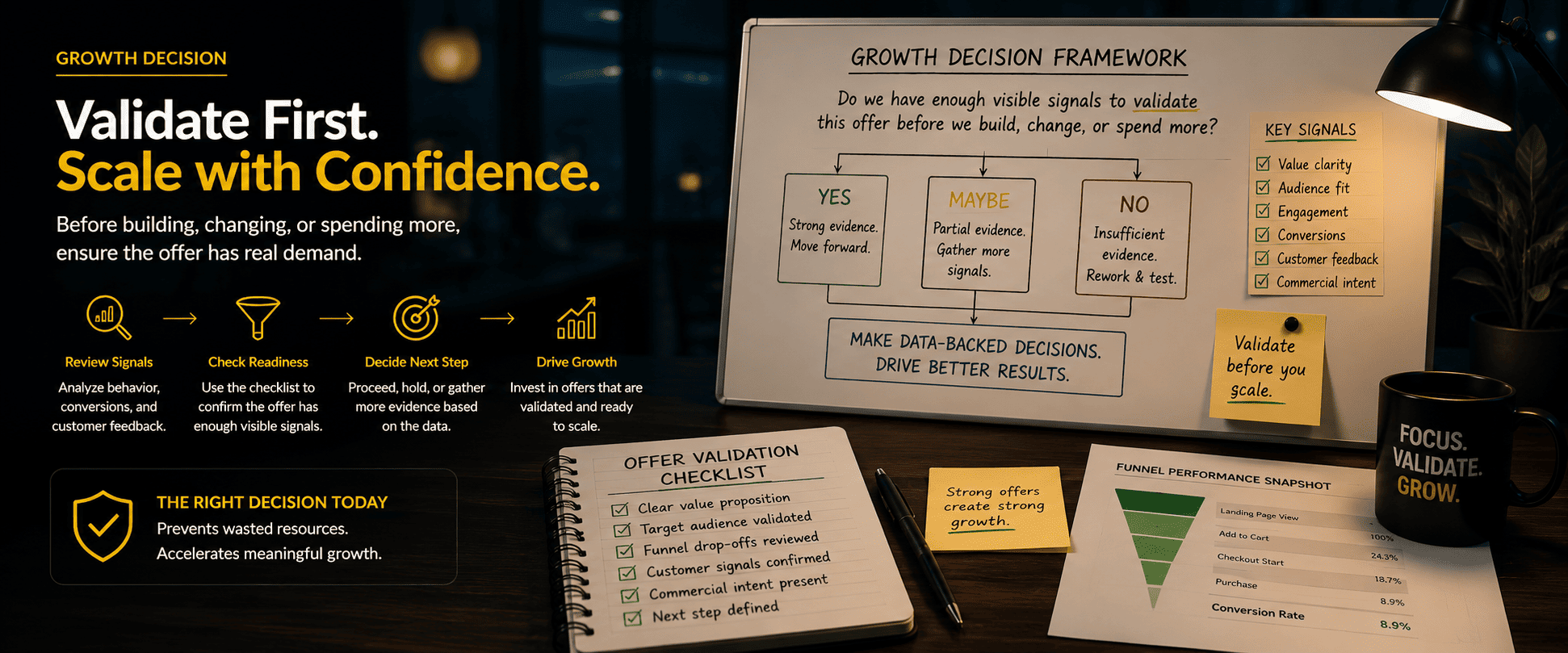
The Offer Validation Readiness Checklist exists to separate real demand from casual interest. It checks whether buyers understand the offer, care enough to take a meaningful action, and show behavior that is stronger than a click or a kind word. If the signals are not there yet, the review produces a hold note and a fix list. If they are, it produces a readiness label with a named caveat.
- Before greenlighting the next action, ask whether the strongest signal in the test would still matter if you removed internal enthusiasm from the equation.
- A booked call, a checkout start, a payment attempt, or a repeated buyer question is a commitment signal. A page visit, a like, or a positive comment is attention. Do not confuse the two.
The minimum validation signal is a behavior that costs something
The first question in any offer validation is whether the test captures a signal that costs the buyer time, money, or attention. Low effort signals can be useful as directional input. They should never be treated as proof. A test that only measures impressions, page views, or form submissions is measuring curiosity. A test that measures booked calls, payment attempts, or qualified lead movement is measuring commitment.
If the validation path cannot capture a commitment signal at all, the test should stay in planning mode. Sending more traffic to a page that only generates curiosity will not suddenly produce commitment. It will just produce more curiosity, faster, and the team will misinterpret the volume as validation.
- Define one observable behavior that proves a buyer moved from interest to intent. If you cannot name one, the test is not ready.
- Check whether the signal connects directly to the page, offer, or experiment decision being reviewed. A signal from an unrelated channel is noise, not evidence.
If the buyer cannot explain your offer, the message is not ready
An offer is not validated if buyers cannot understand what problem it solves or why it matters now. The message needs to build enough belief before it asks for action. If the page skips proof, process clarity, price context, or next step confidence, sending more traffic will scale confusion, not conversions.
When message readiness is weak, the fix is a message or page review. Not more traffic. Not a bigger ad budget. The reviewer should check whether the CTA matches the buyer's actual readiness. Asking for a purchase when the buyer is still trying to understand the problem creates friction that looks like disinterest in the data. It is actually a messaging gap.
- Read the page out loud as if you are the buyer. Can you explain what the offer does and why it matters in one sentence? If not, the message has a clarity problem.
- Check whether price, risk, and process concerns are addressed on the page. Unanswered objections are silent conversion killers.
Separate what you measured from what you assumed
Offer validation often depends on scenario math. Traffic estimates, stage conversion rates, order values, and payback windows. These numbers are useful for modeling. They are dangerous when treated as observed evidence. If the model is sensitive to an assumed conversion rate or a guessed revenue number, the recommendation should stay as a scenario until the source is verified.
This is the most common failure in offer validation. The team builds a spreadsheet that looks convincing, and the spreadsheet becomes the evidence. Nobody checks which numbers came from real data and which came from hope. The reviewer should label every input as observed or assumed, test which assumption changes the outcome most, and hold the decision until that number is grounded.
- List every number in the scenario model and mark each one as observed or assumed. If more than half are assumed, the model is not ready for a decision.
- Identify the single assumption that most changes the outcome. That is the one to verify first before approving any growth action.
A payment is a signal. Revenue quality is a deeper read.
A test that generates payments feels like the strongest possible validation. But a payment is the start of a question, not the end of one. Revenue-informed analysis should distinguish sales activity from durable revenue quality. Stripe records may show charges. The team still needs to review cash timing, order quality, margin, refund patterns, and payback risk before treating the offer as validated.
If revenue quality or cash timing is unclear, the reviewer should avoid turning early payment activity into a payback conclusion. The recommendation stays caveated until the commerce evidence is reviewed in full. A spike in payments during a launch week is not the same as a repeatable revenue pattern over a full cycle.
- Open Stripe or your payment records and check refund rates, chargeback volume, and the time gap between purchase and cash settlement.
- Compare payment behavior to CRM lead state. A payment from a qualified lead is validation. A payment from someone who misunderstood the offer is a future refund.
A weak result is not always a weak offer
When a validation test underperforms, the instinct is to blame the offer. But the problem may be operational. There may be no follow-up owner. No promotion. Weak delivery. A lead form that routes to the wrong inbox. A sales team that never received the handoff. These are operating leaks, not funnel leaks.
The reviewer should separate the two before recommending a creative or offer change. If the operating owner or follow-up path is unclear, the recommendation should be a process fix before a creative fix. Fixing the offer when the system around it is broken is like repainting a car that has no engine.
- Trace the full path from buyer action to team response. If there is a gap where nobody is accountable, that is the constraint.
- Check whether customer feedback, delivery quality reports, and sales call notes reached the reviewer. If they did not, the operating loop is not closed.
Sample Review Note
OpenAnalyst should review Offer Validation Readiness Checklist, compare the decision evidence with the caveats, and keep the next recommendation approval-gated until the reviewer accepts it.
Reviewed: Offer validation for [offer name]. Buyer problem clarity, commitment signals, message readiness, scenario math, revenue quality, and operating path checked. Decision: [Approve / Hold / Send back]. Hold condition: [specific trigger]. Owner: [Name]. Next review: [Date].