Why a YouTube Shorts growth decision memo matters
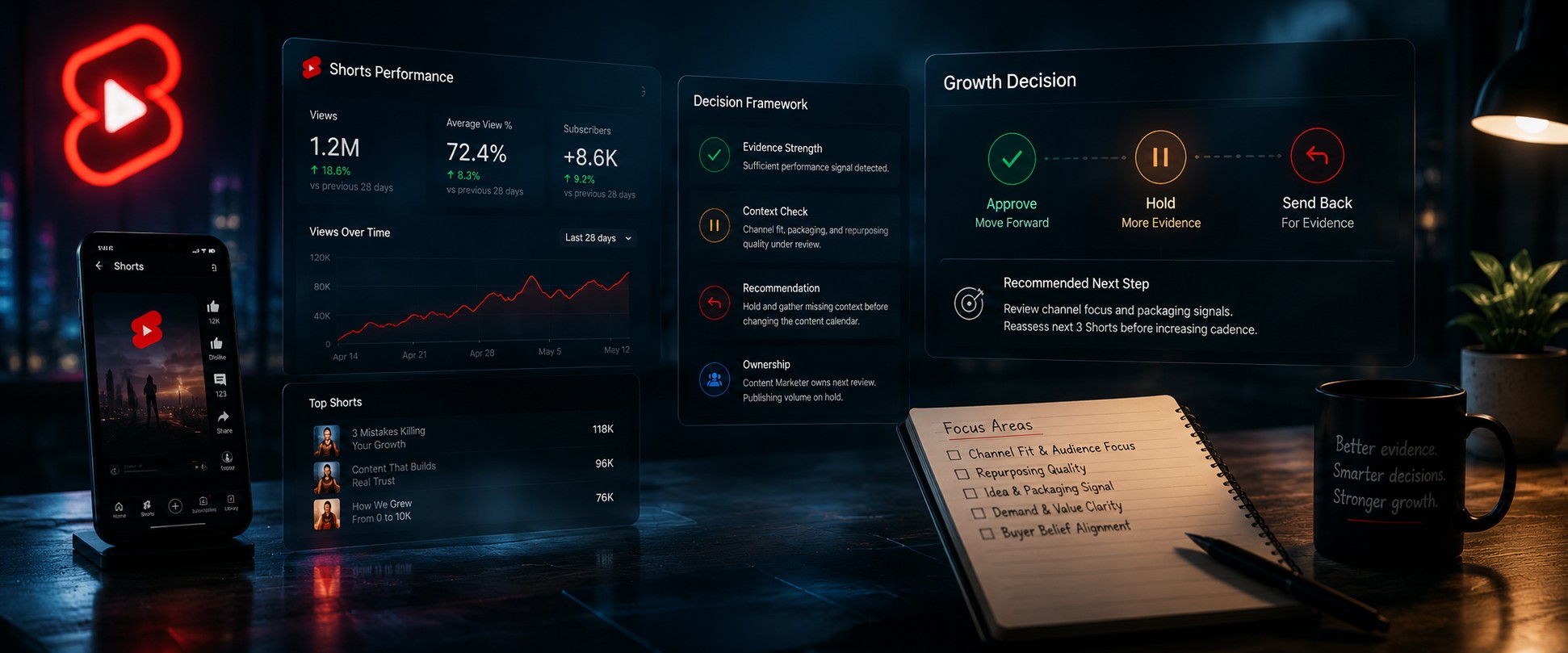
A YouTube Shorts growth review should not end with a vague statement like “performance is down” or “post more often.” The useful output is a decision memo that tells the content marketer what to do next, what evidence supports that action, what caveat should stay visible, and whether the recommendation is approved, held, or sent back for stronger evidence.
This matters because short-form growth problems are easy to misread. A weak Shorts result may look like a volume problem when it is really a channel-focus problem. A repurposed clip may look ready because the original content was strong, even though the short version removed the context that made the original useful. A topic may seem promising, but the hook, title, or opening frame may fail to signal who the video is for.
The memo exists to prevent those false-ready decisions. It gives the marketer a clear operating answer before the team changes the publishing calendar, repurposes more assets, or increases production cadence.
The decision this memo should answer
The core decision is simple:
Should the team approve the next YouTube Shorts action, hold it until more evidence is available, or send it back for revision?
The memo should not only describe the data. It should connect the finding to a practical content decision. The team needs to know whether to publish more, change packaging, narrow the content lane, improve repurposing quality, or pause until the evidence is stronger.
A strong memo should answer four operational questions:
- What decision is the content marketer trying to make?
- Which input would make the marketer trust the growth read?
- What caveat should remain visible before action is taken?
- Who owns the next action if the review is approved?
What evidence should be reviewed
The memo should combine performance signals with operating context. YouTube data can show what moved, but it rarely explains the full reason by itself. Google Analytics, Google Sheets, CRM notes, and operator notes help connect the visible performance movement to the actual publishing and marketing decision.
YouTube should be used to understand the visible Shorts performance pattern. The reviewer should look for changes in views, retention, audience behavior, traffic sources, returning viewers, and video-level differences. However, the memo should avoid treating YouTube movement as complete proof unless the channel fit and packaging context are also clear.
Google Analytics can help determine whether Shorts activity is contributing to meaningful downstream behavior. If a video performs well inside YouTube but does not support site visits, lead quality, or campaign movement, the recommendation may need to be more cautious.
Google Sheets often contains the operating layer: publishing cadence, content calendar changes, repurposing status, assigned owners, and planned follow-ups. The memo should use this source to confirm what action is actually being proposed.
CRM context can help connect content topics to buyer beliefs, objections, or audience segments. If the Shorts content is not mapped to a real buyer concern, the team may be optimizing for views without improving marketing usefulness.
Operator notes are important because they explain what the team already knows, what assumptions are being made, and what constraints affected the content. The memo should separate evidence from opinion, but it should still preserve operational context.
How to write the finding
The finding should state what changed and what the reviewer believes it means. It should be specific enough to support a decision, but careful enough not to overclaim.
A weak finding sounds like this:
Shorts performance is not strong, so the team should post more.
A stronger finding sounds like this:
Recent Shorts show limited growth movement, but the evidence does not yet prove that cadence is the main constraint. The channel focus and packaging signals should be reviewed before increasing production volume.
The stronger version is better because it separates the visible movement from the uncertain cause. It also tells the team what should happen before the recommendation is approved.
How to write the caveat
The caveat is one of the most important parts of the memo. It protects the team from acting as if the evidence is stronger than it is.
For a YouTube Shorts growth decision memo, the caveat should usually focus on one of three risks:
The caveat should not be buried at the end. It should stay visible near the recommendation because it directly affects whether the action should be approved.
- The channel may not be focused enough for the audience or recommendation system.
- The repurposed asset may have lost the original context that made it useful.
- The idea may be useful, but the package may not make the value obvious quickly enough.
How to write the recommendation
The recommendation should state what changes, what stays held, and what evidence would make the decision stronger.
For example:
Hold the cadence increase. Before publishing more Shorts, review whether the current content lane is clear enough for a specific audience and whether the next three Shorts make the viewer value obvious in the first seconds.
This recommendation is useful because it does not only say “hold.” It explains what must be checked before approval. It also gives the marketer a practical next step.
Approval states
The memo should end with a clear approval state. The three most useful states are:
Use this when the evidence is strong enough to move forward. The memo should still name the owner, next action, and any monitoring requirement.
Use this when the action may be valid, but the evidence is not strong enough yet. The memo should explain what information is missing.
Use this when the recommendation is not decision-ready. The reviewer should identify what needs to be revised, checked, or clarified before the memo can be approved.
Common failure modes
The first failure mode is treating memo quality as settled before checking whether the memo separates visible performance movement from missing context. A Shorts review can show weak growth, but the cause may still be unclear.
The second failure mode is skipping the YouTube channel fit and audience focus caveat. When this happens, the next step can look safer than the evidence allows.
The third failure mode is moving follow-up work forward before the content repurposing quality rule is accepted. Repurposed Shorts should not become generic filler. They should preserve the useful insight, proof, or decision from the original source.
Checks before approval
Before the memo is approved, the reviewer should check whether the memo separates visible performance movement from missing or uncertain context.
The reviewer should also check whether the channel is focused enough for the audience and recommendation system to understand what the next video is for.
If the team is repurposing content, the reviewer should confirm that the repurposed asset preserves the original context while fitting the Shorts format.
The reviewer should also check whether the next content idea has visible demand and a package that makes the value obvious.
A good idea can underperform if the viewer cannot quickly understand who it is for or why it matters.
Finally, the creative message should be mapped to the buyer belief or objection it is supposed to move. This keeps the Shorts review connected to marketing outcomes instead of only platform metrics.
Example decision memo structure
Recent YouTube Shorts performance does not yet show a reliable growth pattern. Some movement is visible, but the evidence does not prove that publishing volume is the main constraint.
The current read may be affected by channel focus, audience clarity, or weak packaging. The team should avoid increasing cadence until the next Shorts clearly signal the audience, value, and reason to watch.
Hold the cadence increase. Review the content lane, revise the next hooks and titles, and confirm whether the repurposed clips preserve the original insight before scheduling more Shorts.
Held pending evidence. The content marketer owns the next review, while additional publishing volume stays on hold.
Final field note
10X should review the YouTube Shorts Growth Decision Memo, compare the decision evidence with the caveats, and keep the next recommendation approval-gated until the reviewer accepts it.
Sample review note
10X should review YouTube Shorts Growth Decision Memo, compare the decision evidence with the caveats, and keep the next recommendation approval-gated until the reviewer accepts it.