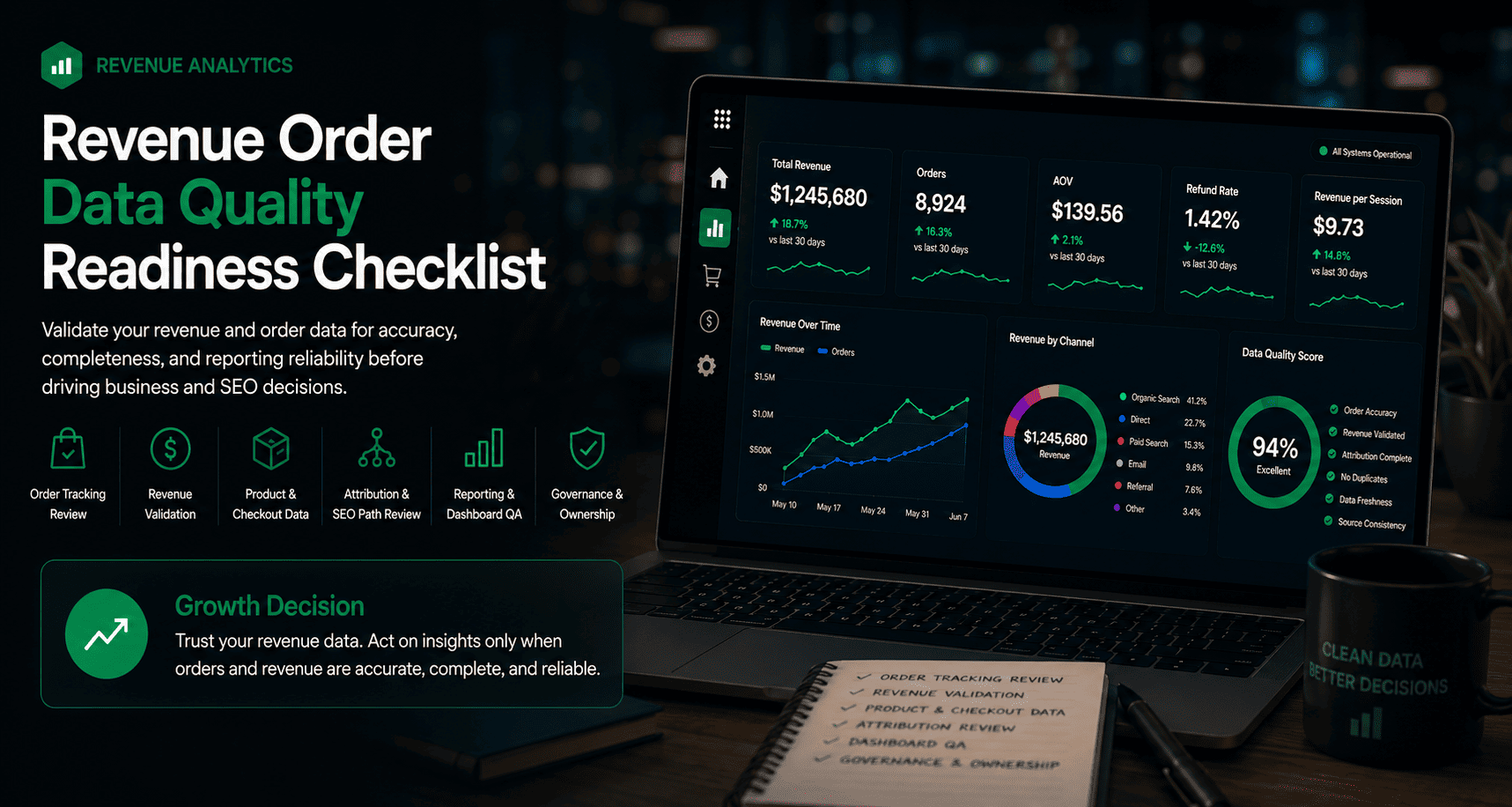
Common Revenue Data Quality Failures That Distort Analysis
Many reporting issues originate long before analysts begin reviewing dashboards. Revenue datasets often pass basic validation checks while still containing structural weaknesses that can significantly affect decision quality. These weaknesses may remain hidden until teams attempt cohort analysis, attribution reviews, forecasting exercises, or customer-value calculations.
One common issue involves duplicate transaction records. Duplicate orders can occur because of import failures, integration retries, synchronization problems, or inconsistent transaction identifiers. Even a small duplication rate can inflate reported revenue and distort performance comparisons across periods.
Another common issue involves incomplete order records. A transaction may appear valid while missing discount information, customer identifiers, shipping costs, refund status, or margin data. These omissions create situations where revenue appears complete even though critical context required for interpretation is unavailable.
Reviewers should also be aware of reporting fragmentation. Revenue data is often distributed across ecommerce systems, analytics platforms, CRM environments, payment processors, fulfillment systems, and financial reporting tools. When these systems disagree, analysts must determine which source represents the authoritative record before conclusions are drawn.
Identifying these failure modes early helps prevent revenue-informed recommendations from becoming dependent on unreliable evidence.
- Duplicate transaction records.
- Missing customer identifiers.
- Refund-processing delays.
- Incomplete revenue attribution.
- Cross-system reconciliation failures.
- Margin calculation inconsistencies.
- Date-range mismatches.
- Forecasting assumptions applied incorrectly.
Revenue Data Governance and Operational Accountability
Revenue reporting should never exist without ownership. One of the primary goals of a readiness review is identifying who owns the evidence, who validates the data, who approves the recommendation, and who is responsible for resolving unresolved caveats.
Many organizations assume that because revenue data exists, it can automatically be trusted. In reality, trust depends on governance. Without defined ownership, reporting discrepancies often remain unresolved because no team is responsible for validating assumptions or correcting data-quality issues.
A mature revenue governance process typically involves multiple stakeholders:
The readiness review should document ownership clearly so recommendations remain connected to accountable decision-makers rather than anonymous reporting outputs.
- Commerce teams responsible for transaction systems.
- Analytics teams responsible for measurement integrity.
- Finance teams responsible for revenue definitions.
- Marketing teams responsible for growth interpretation.
- Leadership stakeholders responsible for approval decisions.
Using Revenue Data in Growth and SEO Decisions
Revenue data frequently influences decisions far beyond finance reporting. SEO teams use revenue information to evaluate content opportunities, identify high-value landing pages, prioritize optimization efforts, and measure business impact. Growth teams use revenue reporting to evaluate campaign performance, acquisition quality, and channel efficiency.
However, revenue movement should not automatically trigger action. An increase in revenue may result from seasonal demand, pricing changes, promotional activity, attribution adjustments, or reporting updates rather than genuine growth.
Similarly, a decline in revenue does not necessarily indicate a performance problem. Inventory constraints, fulfillment delays, payment-processing issues, or reporting corrections can influence reported outcomes.
The readiness review helps ensure that teams understand the commercial context behind revenue movement before changing content priorities, acquisition strategies, budget allocations, or forecasting assumptions.
- Validate whether revenue growth reflects real business improvement.
- Review attribution assumptions before channel prioritization.
- Confirm customer quality aligns with revenue growth.
- Evaluate profitability alongside topline performance.
- Separate operational issues from marketing performance signals.
Evidence Hierarchy for Revenue-Based Recommendations
Not every metric should carry equal influence during decision-making. Revenue reporting often contains primary evidence, supporting evidence, and contextual evidence. A readiness review should distinguish between these categories to prevent weaker indicators from overriding stronger signals.
Primary evidence includes measurements directly tied to the business outcome being evaluated. Supporting evidence helps explain why the outcome occurred. Contextual evidence provides additional information but should not independently justify action.
For example, verified net revenue may represent primary evidence. Order volume trends may provide supporting evidence. Website engagement metrics may provide contextual evidence. While all three contribute to understanding performance, they should not be weighted equally.
Establishing an evidence hierarchy improves analytical discipline and reduces the likelihood of recommendations being driven by convenient metrics instead of decision-relevant measurements.
When Revenue Data Should Not Be Used as Decision Evidence
One of the most valuable outcomes of a readiness review is identifying situations where revenue data should not be trusted. Analysts often feel pressure to provide recommendations even when the evidence remains incomplete. However, a hold decision is frequently more valuable than a recommendation built on weak assumptions.
Revenue data should remain unsuitable for decision-making when:
Maintaining a hold state protects the organization from making strategic decisions that may later require reversal when reporting quality issues are discovered.
- Order integrity has not been verified.
- Customer identity logic remains inconsistent.
- Revenue definitions differ between stakeholders.
- Reporting periods are not aligned.
- Margin considerations are missing.
- Attribution assumptions remain unresolved.
- Source systems cannot be reconciled.
- Ownership is unclear.
Building a Repeatable Revenue Quality Review Process
The strongest organizations do not perform revenue-quality validation only when problems appear. Instead, they build repeatable review systems that continuously monitor transaction integrity, customer identity quality, reporting consistency, margin assumptions, and governance controls.
A repeatable readiness process allows teams to identify data-quality risks before they affect reporting. It also improves stakeholder confidence because recommendations consistently reference validated evidence rather than ad hoc interpretations.
Over time, these practices create a more reliable analytical environment where revenue-informed decisions can move faster because the quality of the supporting evidence has already been established.
The ultimate purpose of the Revenue and Order Data Quality Readiness Checklist is not simply to validate data. It is to ensure that every recommendation built on revenue evidence remains connected to trustworthy transactions, defensible business logic, documented caveats, and clearly assigned ownership before operational action is approved.
Commerce and revenue quality
Evidence to review: Product performance, order quality, payment signal, cash timing, and margin or payback caveat.
- Connect campaign or funnel movement with commerce and payment context before judging quality.
- If revenue quality or cash timing is missing, avoid turning source movement into a payback conclusion.
- Commerce and revenue quality is supported by visible inputs and the caveat is clear.
Paid social scaling signal quality
Evidence to review: Spend change, result volume, efficiency movement, frequency or fatigue signal, downstream quality, and approval state.
- Separate a real scale signal from short-term platform movement or unqualified volume.
- If volume or quality is not strong enough, keep the recommendation as a staged review rather than a scale action.
- Paid social scaling signal quality is supported by visible inputs and the caveat is clear.
Operating failure modes
Evidence to review: Implementation status, lead flow, delivery quality, follow-up owner, and customer-result feedback.
- Separate a funnel leak from an operating leak, such as no follow-up, no promotion, weak delivery, or no owner.
- If the operating owner or follow-up path is unclear, mark the recommendation as a process fix before a creative fix.
- Operating failure modes is supported by visible inputs and the caveat is clear.
Conversion quality and measurement confidence
Evidence to review: Conversion action, diagnostic event, downstream quality source, attribution caveat, and value signal.
- Separate decision-driving conversions from diagnostic events and caveated attribution signals.
- If conversion quality is unknown, keep the recommendation caveated until the downstream source is reviewed.
- Conversion quality and measurement confidence is supported by visible inputs and the caveat is clear.
Order grain evidence
Evidence to review: Row grain label, order identifier, item field, duplicate order check, row count, and export owner.
- Check whether the export shows one row per order, line item, or customer summary before totals are compared.
- Hold when mixed row grain or duplicate order rows could inflate revenue, order count, or customer value.
- Order grain evidence is supported by visible inputs and the caveat is clear.
Sample review note
10X should review Revenue and Order Data Quality Readiness Checklist, compare the decision evidence with the caveats, and keep the next recommendation approval-gated until the reviewer accepts it.