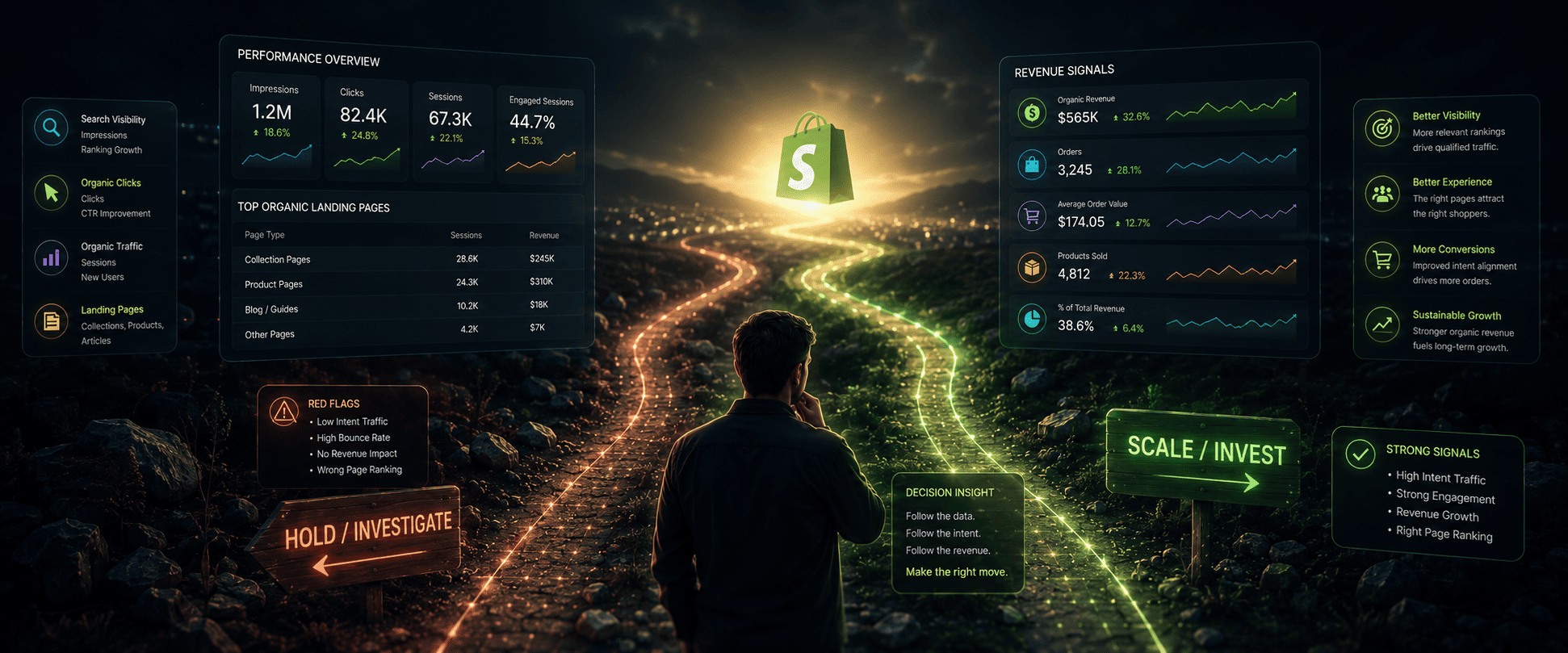
Shopify Organic Revenue Signal Review
Shopify SEO performance should not be judged by rankings or traffic alone. A store may gain organic sessions, earn more impressions, or improve positions for target keywords while still failing to create qualified revenue. Organic growth only becomes a stronger roadmap signal when the team can connect search movement to buyer intent, page quality, product fit, order context, and revenue evidence.
The Shopify Organic Revenue Signal Review helps ecommerce teams decide whether Shopify SEO is creating qualified organic revenue or only traffic and ranking movement. The review evaluates which signals prove business value, which signals are only leading indicators, and whether the SEO roadmap should scale, hold, reprioritize, or investigate.
The goal is not to dismiss ranking gains. Rankings and traffic matter. But they should explain revenue movement, not replace it. If the evidence is incomplete, the recommendation should stay caveated until the reviewer accepts the roadmap decision.
What This Workflow Decides
The workflow answers one practical question: does the available evidence support more SEO investment, a hold note, or a different page priority? A recommendation should move forward only when organic movement connects to qualified buyer behavior and Shopify revenue context.
- Scale: Organic traffic, page intent, conversion behavior, and revenue evidence support more SEO investment.
- Hold: Traffic or ranking movement is visible, but revenue quality or attribution remains unclear.
- Reprioritize: Growth is coming from weak-intent pages while better commercial pages need attention.
- Investigate: Search movement, orders, attribution, or page intent conflict and need more review.
- Send back for evidence: The team needs stronger GA4, Search Console, Shopify order, or conversion context before action.
Separate Revenue Signals From Leading Indicators
Organic rankings, impressions, clicks, and sessions are leading indicators. They show that visibility may be changing, but they do not prove qualified revenue. The reviewer should use these signals to explain what may be happening before declaring business impact.
If a ranking gain happens on a low-intent article or informational page, it may support awareness but not justify immediate investment in commercial SEO work. If a collection page gains fewer clicks but produces stronger orders, it may deserve more attention than a high-traffic page with weak buyer quality.
- Ranking gains: Useful when they occur on pages that match buyer intent.
- Search Console clicks: Useful when the queries are commercial or category-relevant.
- Organic sessions: Useful when the landing pages support product discovery or purchase behavior.
- Engagement events: Useful as diagnostic signals, not final proof of SEO value.
- Organic revenue: Stronger when connected to orders, product fit, attribution, and page type.
Review Organic Traffic Quality
GA4 organic traffic data helps the team understand what visitors do after arriving from search. The review should check whether organic visitors engage with relevant product pages, move through the funnel, and reach actions that can support revenue conclusions.
Traffic growth without qualified behavior should not automatically approve more SEO investment. It may mean the store is attracting research visitors, weak-intent queries, or mismatched landing pages.
- Which landing pages receive organic traffic?
- Do organic visitors reach product, collection, cart, or checkout steps?
- Are sessions coming from buyer-intent queries or discovery queries?
- Does engagement differ by page type?
- Do organic sessions connect to conversion events or orders?
Connect Search Console And Query Data To Page Intent
Search Console query data helps explain whether organic movement belongs to the right Shopify page. A query may be better owned by a collection page, product page, buying guide, comparison page, or support article. If the wrong page is earning visibility, revenue may remain weak even while impressions increase.
The review should separate visibility from ownership. A page can rank and still be the wrong destination for the buyer job. When that happens, the roadmap may need page reprioritization instead of more content or link work on the current URL.
- Do target queries match the page type?
- Are collection pages ranking for category-led demand?
- Are product pages ranking for product-specific queries?
- Are articles attracting traffic that should be routed to commercial pages?
- Does the page type map show which URLs should own search demand?
Review Shopify Order And Revenue Context
Shopify order context is essential before claiming that SEO is producing qualified organic revenue. The reviewer should inspect whether organic movement connects to orders, product mix, revenue trend, average order value, margin context, or repeat purchase behavior where available.
Visible revenue is useful, but it should stay caveated when attribution is uncertain. If the team cannot connect revenue cleanly to organic movement and buyer-quality evidence, the recommendation should not be treated as fully approved.
- Are organic sessions connected to actual orders?
- Which products or collections contribute to organic revenue?
- Is revenue coming from commercially important inventory?
- Does organic traffic support healthy order quality?
- Are attribution or payment timing caveats visible?
Translate Evidence Into A Roadmap Decision
The output should be a roadmap decision note, not a loose analytics summary. The note should state what changed, which evidence supports the read, what caveat remains, and what action the reviewer can approve.
This keeps the team from using traffic as a substitute for revenue evidence and helps prevent investment from moving toward pages that do not support commercial growth.
- Scale SEO work when organic revenue, page intent, and conversion context align.
- Hold investment when traffic rises but revenue or attribution evidence is weak.
- Reprioritize pages when organic movement appears on the wrong page type.
- Investigate further when rankings, sessions, orders, and revenue tell different stories.
Common Failure Modes
The most common mistake is treating organic movement as a growth decision before checking whether it creates qualified revenue. Another mistake is declaring SEO value from rankings without reviewing clicks, page mix, buyer intent, orders, and conversion context. A third failure is skipping the attribution caveat, which can make the next roadmap action look safer than the evidence allows.
- Approving SEO investment from traffic growth alone.
- Using ranking gains as proof without revenue context.
- Ignoring page type and buyer intent mismatch.
- Missing attribution uncertainty around organic revenue.
- Moving follow-up work forward before reviewer approval.
Final Approval Rule
A Shopify Organic Revenue Signal Review should end with a clear approve, hold, reprioritize, or investigate recommendation. Approve roadmap changes only when organic movement connects to qualified revenue, page intent, Shopify order context, and conversion evidence.
If traffic rises but revenue does not, hold the recommendation and inspect page intent, product fit, attribution, and order quality. 10X can draft the evidence note, but the SEO roadmap change should remain approval-gated until the reviewer accepts the caveat, owner, and next action.
Sample review note
10X should review Shopify Organic Revenue Signal Review, compare the decision evidence with the caveats, and keep the next recommendation approval-gated until the reviewer accepts it.