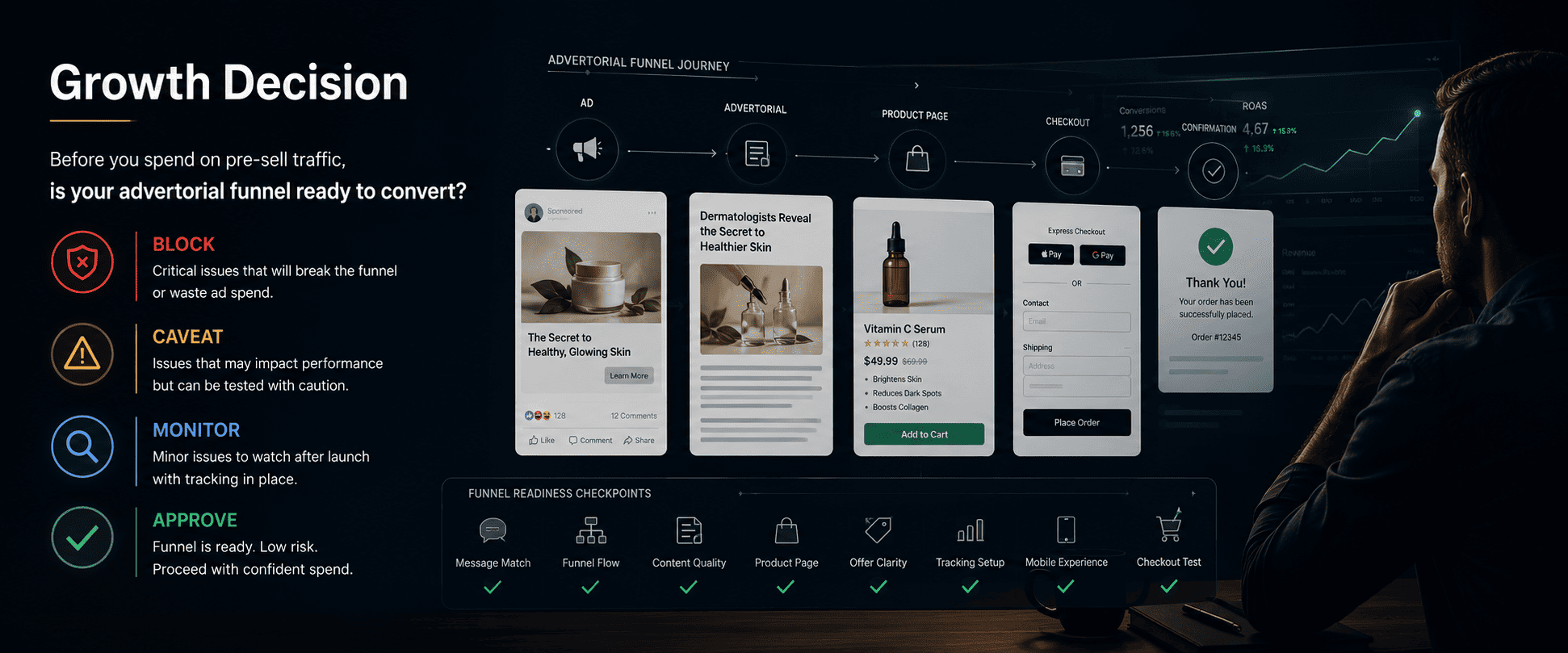
Ecommerce Advertorial Funnel Readiness Review Before Paid Traffic Launch
Running paid traffic to an ecommerce advertorial funnel before validating readiness can waste budget quickly. Ads may generate clicks, traffic may appear healthy, and the landing page may look polished, but hidden friction inside the funnel often reduces conversion performance before the campaign has a chance to scale.
An ecommerce advertorial funnel readiness review helps teams audit message alignment, page continuity, funnel structure, and conversion readiness before spending on traffic. It creates a practical workflow for identifying weak points early so budget goes toward validated paths instead of broken journeys.
For ecommerce ads teams, this review matters because advertorial funnels rely on trust, storytelling, and smooth conversion flow. If ad promise and landing experience feel disconnected or checkout contains friction, conversion rate drops and paid acquisition efficiency becomes harder to improve.
Why Funnel Readiness Should Be Reviewed Before Spending
Advertorial campaigns often depend on emotional hooks, educational content, product framing, and a strong transition into the offer page.
Even small disconnects between ad and page can reduce:
A readiness review protects spend and improves launch confidence.
- Click-through confidence
- Page engagement
- Scroll depth
- Add-to-cart rate
- Checkout completion
- Return on ad spend
1. Review Ad-to-Advertorial Message Match
The first checkpoint is message continuity.
A user clicks because the ad creates an expectation. The advertorial should immediately reinforce that expectation.
Review:
Example:
An ad promises “3 reasons this skincare ingredient improves texture.” The advertorial should open with that promise clearly before moving deeper into the story.
If the landing page feels unrelated, users leave quickly.
- Main promise in ad headline
- Opening hook on advertorial
- Offer positioning
- Visual consistency
- Problem framing
- Trust-building elements
2. Audit Advertorial Content Flow
Advertorials must guide users through a clear sequence.
Watch for:
The goal is continuity from curiosity to buying intent.
- Hook
- Problem awareness
- Education
- Product connection
- Social proof
- Offer transition
- Call to action
- Weak opening section
- Long paragraphs without momentum
- Missing proof
3. Validate Funnel Continuity
The path after the advertorial matters just as much as the article itself.
Review movement between:
Check for:
A single broken transition can stop conversions completely.
- Ad → advertorial
- Advertorial → product page
- Product page → cart
- Cart → checkout
- Checkout → confirmation
- Broken links
- Slow transitions
- Page reload issues
- Tracking redirects
- Missing CTA buttons
4. Review Conversion Readiness on Product Page
Once users leave the advertorial they should feel ready to buy.
Audit:
The product page should feel like a natural continuation of the advertorial story.
- Product headline clarity
- Pricing visibility
- Discount visibility
- Shipping details
- Testimonials
- Trust badges
- Product imagery
- CTA placement
5. Test Mobile Funnel Experience
Many ecommerce ad campaigns receive majority mobile traffic.
Review:
Mobile friction increases bounce rate quickly.
- Page speed
- Image loading
- Sticky CTA visibility
- Text readability
- Scroll friction
- Checkout usability
6. Review Analytics and Test Readiness
Before launch, confirm measurement works.
Without clean measurement teams cannot optimize paid spend accurately.
- Page view tracking
- CTA click events
- Add-to-cart
- Checkout start
- Purchase confirmation
- Attribution parameters
7. Diagnostic Workflow Before Launch
Review live ads Match landing message Complete full test journey Check product page readiness Verify checkout Confirm analytics Review mobile Approve launch
- Review live ads
- Match landing message
- Complete full test journey
- Check product page readiness
- Verify checkout
- Confirm analytics
- Review mobile
- Approve launch
Common Issues Found During Reviews
Headline mismatch Weak story-to-offer transition Hidden CTA buttons Broken checkout links Slow mobile loading Missing trust proof Tracking gaps Offer confusion
- Headline mismatch
- Weak story-to-offer transition
- Hidden CTA buttons
- Broken checkout links
- Slow mobile loading
- Missing trust proof
- Tracking gaps
- Offer confusion
Final Takeaway
An ecommerce advertorial funnel readiness review helps teams catch weak paths before paid traffic starts spending.
It improves message match, protects budget, strengthens conversion flow, and creates a better experience from first click through purchase.
When advertorial content, product pages, and checkout experience work together clearly, paid campaigns scale with stronger conversion efficiency and fewer wasted clicks.
Sample review note
10X should review Ecommerce Advertorial Funnel Readiness Review, compare the decision evidence with the caveats, and keep the next recommendation approval-gated until the reviewer accepts it.