10X

Report Artifact

Lifecycle Revenue Scorecard

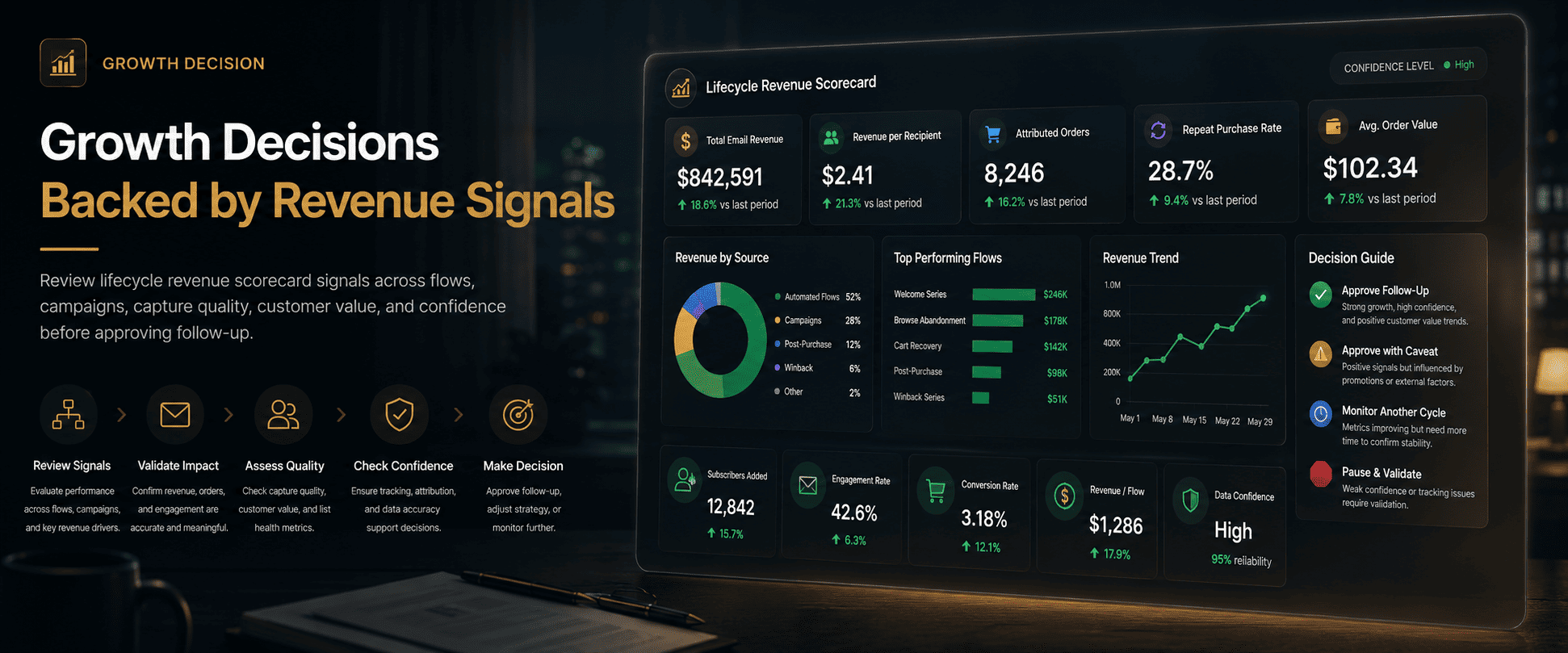
Review lifecycle revenue scorecard signals across flows, campaigns, capture quality, customer value, and confidence before approving follow-up.

ReportEmail Revenue Analysis
Lifecycle Revenue Scorecard

Decision frame

What this workflow decides

Decide which lifecycle revenue signal should be reviewed, monitored, or converted into an approval-ready action.

10X review note

OpenAnalyst should compare Flows with Is cadence helping?, name the caveat that could change the lifecycle revenue scorecard recommendation, and keep follow-up approval-gated.

Lifecycle Revenue Scorecard for Email Revenue Analysis and Decision Review

Lifecycle email performance often looks healthy at the surface because revenue totals, campaign sends, or automation reports appear active. But activity alone does not prove that lifecycle email is driving reliable revenue growth.

A lifecycle revenue scorecard helps teams review whether flows, campaigns, list capture quality, customer value, and conversion signals are producing measurable business impact before approving the next action.

The goal is not simply reporting email revenue. The goal is understanding whether the visible revenue signals are strong enough to support a confident lifecycle recommendation.

Why Lifecycle Revenue Scorecards Matter

Revenue from email often comes from multiple moving parts:

  • Automated lifecycle flows
  • Campaign performance
  • Subscriber growth
  • Repeat customer behavior
  • Promotional timing
  • Offer quality
  • Tracking setup

A scorecard separates healthy revenue contribution from temporary spikes, tracking gaps, or misleading attribution.

Core Revenue Signals to Review

1. Flow Revenue Contribution

  • Welcome flow revenue
  • Browse abandonment revenue
  • Cart recovery revenue
  • Post-purchase revenue
  • Winback flow revenue

This confirms whether automation is contributing consistently.

2. Campaign Revenue Performance

  • Revenue per campaign
  • Revenue per recipient
  • Conversion rate
  • Click-through rate
  • Promotion performance

This shows how revenue changes with send strategy and offers.

3. Capture Quality

  • Subscriber growth
  • Qualified signups
  • Segment match quality
  • Bounce trends
  • Spam complaints

List growth matters only when subscriber quality supports revenue.

4. Customer Value Trends

  • Average order value
  • Repeat purchase rate
  • Customer lifetime value
  • Segment revenue contribution
  • Purchase frequency

This helps connect email revenue to customer value.

5. Confidence Review

  • Attribution consistency
  • Tracking quality
  • Revenue validation
  • Segment accuracy
  • Implementation reliability

A recommendation should not move forward if confidence is weak.

Scorecard Review Questions

  • Are flows driving repeatable revenue?
  • Are campaigns converting efficiently?
  • Is subscriber growth producing buyers?
  • Which customer segments generate value?
  • Is attribution matching order data?
  • Did revenue spike because of promotions only?
  • Are flows underperforming despite healthy traffic?
  • Is the team confident enough for follow-up?

Example: Strong Lifecycle Revenue Signal

Welcome flow revenue is growing steadily.

Repeat purchase segments convert well, AOV remains healthy, and campaign revenue aligns with Shopify reporting.

Decision: Approve follow-up and scale.

Example: Revenue Signal Needs Caveat

Campaign revenue increased sharply during a promotion.

Flow revenue stayed flat and repeat customer value did not improve.

Decision: Caveat performance and monitor next cycle.

Example: Revenue Signal Requires Hold

Dashboard attribution shows growth, but Shopify revenue and segment behavior do not confirm it.

Decision: Pause approval and validate measurement.

Final Decision Framework

  • Approve follow-up
  • Approve with caveat
  • Monitor another cycle
  • Pause and validate

A lifecycle revenue scorecard helps lifecycle marketers move with clarity. It turns visible email activity into measurable revenue confidence, separates healthy signals from noise, and supports better follow-up decisions across flows, campaigns, capture quality, and customer value.

Data sources

  • Email platform data.
  • Company context.
  • Shopify orders.
  • Stripe revenue.
  • HubSpot customer records.
  • Google Analytics behavior.
  • BigQuery or spreadsheet models.

FAQ

What should the reviewer approve after the checklist?

For Lifecycle Revenue Scorecard, the reviewer should approve only the next step tied to flows. If the required evidence for flows is not visible, the output should be a hold note. In this review, the answer should be tied back to the operating rule rather than left as advice. The analyst should state what changes, what stays held, and what evidence would make the recommendation stronger.

Can OpenAnalyst make the change automatically?

No. For Lifecycle Revenue Scorecard, OpenAnalyst can draft the recommendation or follow-up, but execution stays approval-gated. In this review, the answer should be tied back to the operating rule rather than left as advice. The analyst should state what changes, what stays held, and what evidence would make the recommendation stronger.

When is Lifecycle Revenue Scorecard ready to approve?

Lifecycle Revenue Scorecard is ready when the evidence supports the requested action, the owner is named, and the caveat does not change the recommendation. In this review, the answer should be tied back to the operating rule rather than left as advice. The analyst should state what changes, what stays held, and what evidence would make the recommendation stronger.

What should stay held during this review?

For Lifecycle Revenue Scorecard, OpenAnalyst reviews Decide which lifecycle revenue signal should be reviewed, monitored, or converted into an approval-ready action. against the decision evidence and the approval boundary. For the question about What should stay held during this review, the report artifact stays caveated for reports lifecycle revenue scorecard until the relevant evidence is checked and any action is approved.

How should the analyst write the caveat?

For Lifecycle Revenue Scorecard, OpenAnalyst reviews Decide which lifecycle revenue signal should be reviewed, monitored, or converted into an approval-ready action. against the missing context that could change confidence. For the question about How should the analyst write the caveat, the report artifact stays caveated for reports lifecycle revenue scorecard until the relevant evidence is checked and any action is approved.

What makes the examples useful?

For Lifecycle Revenue Scorecard, OpenAnalyst reviews Decide which lifecycle revenue signal should be reviewed, monitored, or converted into an approval-ready action. against the reviewer handoff before any follow-up action. For the question about What makes the examples useful, the report artifact stays caveated for reports lifecycle revenue scorecard until the relevant evidence is checked and any action is approved.

Open the 10X app

Review this workflow with 10X

Preview the analyst report
Lifecycle Revenue Scorecard | OpenAnalyst | 10X