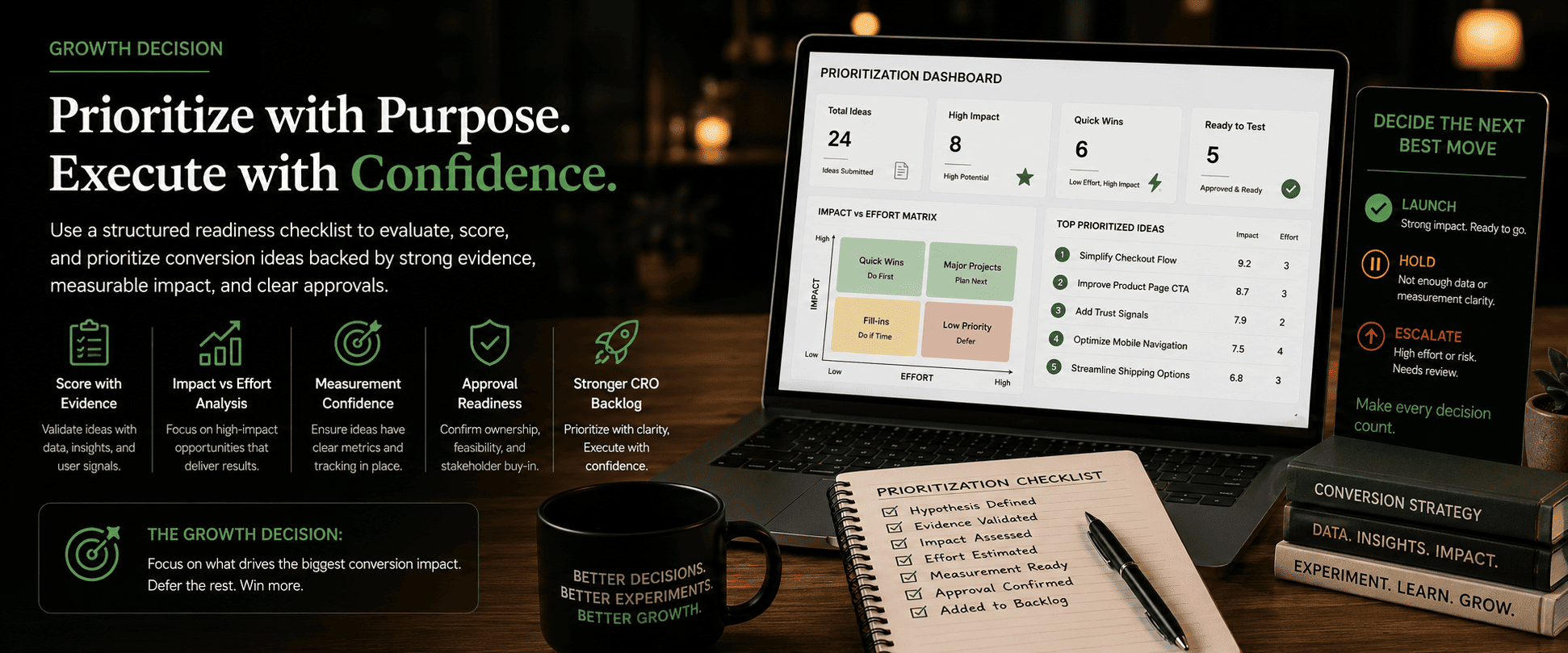
Conversion Optimization Prioritization Readiness Checklist for Funnel Conversion Analysis
Conversion optimization teams almost always have more ideas than available execution time. A landing page headline could be rewritten. A checkout step could be simplified. A CTA placement could move higher. A pricing table could be reorganized. A mobile interaction could be reduced from three clicks to one. None of these ideas are necessarily bad. The challenge is deciding which idea deserves priority first.
That decision becomes harder when multiple teams are involved. Growth may want speed. Product may want deeper validation. Analytics may want stronger reporting confidence. Engineering may want fewer interruptions. Leadership may want measurable results tied to revenue.
A conversion optimization prioritization readiness checklist creates a shared framework before ideas enter the active roadmap. Instead of prioritizing based on urgency, opinions, or the loudest internal request, the team evaluates every idea against evidence, impact, measurement confidence, and approval readiness.
For funnel conversion analysis, this matters because prioritization directly affects how efficiently teams improve conversion performance. The stronger the prioritization process, the stronger the experiments and execution that follow.
Why Conversion Prioritization Needs a Readiness Checklist
Without a structured review, teams often push ideas forward too quickly.
An optimization may sound valuable in a meeting but fail to improve performance once launched. A redesign may consume two weeks of development but produce no measurable lift. A team may spend time debating changes that have weak supporting evidence while higher-value opportunities remain untouched.
Common prioritization problems include:
A readiness checklist prevents those issues by slowing the decision long enough to evaluate what matters.
- Ideas entering backlog without clear business impact
- Weak hypotheses moving into active work
- No shared scoring between teams
- Engineering effort assigned before evidence review
- Unclear ownership
- Incomplete measurement plans
- Stakeholder disagreement after work begins
- Revenue-impact opportunities delayed behind lower-value tasks
Checklist Area One: Hypothesis Specificity
Every conversion idea should begin with a clear hypothesis.
The team should know exactly what changes and why it matters.
Example:
“Move add-to-cart CTA above fold on mobile product pages to reduce scroll friction and improve add-to-cart rate for mobile visitors.”
That is stronger than:
“Improve mobile product page.”
- Which page or funnel step changes?
- Which audience is affected?
- What friction is being solved?
- What behavior is expected to improve?
- Which metric matters?
- What result defines success?
Checklist Area Two: Evidence Strength
Ideas should be supported by observable evidence.
The stronger the evidence, the stronger the prioritization confidence.
A good checklist separates:
That prevents teams from confusing belief with validated opportunity.
- High drop-off on a funnel step
- Session recordings show friction
- Heatmaps reveal ignored CTA zones
- Search behavior shows missing product discovery
- Low click-through on conversion elements
- High mobile abandonment
- User feedback repeating same complaint
- Past experiments validating similar direction
- Confirmed evidence
- Pattern assumptions
Checklist Area Three: Impact vs Effort Evaluation
Not every valuable idea belongs at the top of the roadmap.
A strong prioritization review compares business value against execution effort.
Impact review:
Effort review:
High-impact and low-effort ideas usually deserve priority.
High-effort and low-confidence ideas may remain documented but delayed.
- Estimated lift in conversion
- Potential revenue gain
- Customer experience improvement
- Strategic importance
- Effect on funnel bottleneck
- Engineering hours
- Design requirement
- QA dependency
- Implementation complexity
- Testing time
Checklist Area Four: Measurement Confidence
A conversion idea should be measurable before it is prioritized.
Without measurement readiness, the team may launch something and still fail to learn whether it worked.
Examples:
A measurable idea produces cleaner analysis and faster decisions.
- Relevant tracking exists
- Primary metric defined
- Secondary metric defined
- Traffic volume sufficient
- Attribution reliable
- Reporting dashboard ready
- Segment visibility available
- Timeframe realistic
- Add-to-cart rate
- Checkout completion
Checklist Area Five: Approval & Ownership
Prioritization becomes easier when ownership is clear.
Ownership matters because many CRO ideas cross teams.
A great experiment can still stall if nobody owns implementation.
- Growth owner assigned
- Analytics reviewer assigned
- Engineering confirmed feasibility
- Design aligned
- Timeline approved
- Stakeholder aware
- Decision recorded
Example Prioritization Review
A team reviews four conversion opportunities:
Review shows:
Decision:
The checklist protects focus and keeps effort aligned with impact.
- Reduce checkout fields
- Add social proof on pricing page
- Redesign navigation
- Improve mobile CTA contrast
- Checkout fields have high abandonment evidence
- Pricing page has moderate opportunity
- Navigation redesign has weak proof and heavy effort
- Mobile CTA has strong evidence and quick implementation
- Prioritize checkout fields first
- Launch CTA update next
How This Supports Funnel Conversion Analysis
A structured readiness checklist improves funnel analysis because every priority is tied directly to measurable evidence.
That improves:
Over time, the backlog becomes healthier because weak ideas are filtered early and strong opportunities move faster.
- Experiment quality
- Reporting accuracy
- Execution speed
- Roadmap clarity
- Cross-team trust
- Learning quality
- Revenue visibility
Final Takeaway
A conversion optimization prioritization readiness checklist helps teams decide what deserves immediate action and what should wait.
By reviewing hypothesis specificity, evidence strength, impact-versus-effort fit, measurement confidence, and approval readiness before backlog entry, teams improve execution quality and reduce wasted effort.
The result is cleaner funnel conversion analysis, stronger CRO decisions, faster experimentation cycles, and a prioritization process based on evidence rather than assumptions.
Funnel math and scenario quality
Evidence to review: Traffic unit, stage conversion, offer value, expansion path, revenue timing, and confidence label.
- Separate observed inputs from assumptions before treating a scenario as decision evidence.
- If the model is sensitive to an assumed number, keep the recommendation as a scenario until the source is verified.
- Funnel math and scenario quality is supported by visible inputs and the caveat is clear.
Message friction and belief gaps
Evidence to review: Promise, problem, pain, proof, process, price or effort concern, objection coverage, and call-to-action clarity.
- Review whether the page builds enough emotional and logical belief before it asks for action.
- If the buyer has not been given enough proof, process, or next-step clarity, do not recommend more traffic as the first fix.
- Message friction and belief gaps is supported by visible inputs and the caveat is clear.
Conversion quality and measurement confidence
Evidence to review: Conversion action, diagnostic event, downstream quality source, attribution caveat, and value signal.
- Separate decision-driving conversions from diagnostic events and caveated attribution signals.
- If conversion quality is unknown, keep the recommendation caveated until the downstream source is reviewed.
- Conversion quality and measurement confidence is supported by visible inputs and the caveat is clear.
Commerce and revenue quality
Evidence to review: Product performance, order quality, payment signal, cash timing, and margin or payback caveat.
- Connect campaign or funnel movement with commerce and payment context before judging quality.
- If revenue quality or cash timing is missing, avoid turning source movement into a payback conclusion.
- Commerce and revenue quality is supported by visible inputs and the caveat is clear.
Hypothesis specificity
Evidence to review: Idea, page or funnel area, expected behavior, target metric, and measurement owner.
- Check whether the idea names the page or funnel area, buyer behavior, expected movement, and measurement source.
- Hold when the idea is a preference, cosmetic change, or broad tactic without a measurable behavior.
- Hypothesis specificity is supported by visible inputs and the caveat is clear.
Sample review note
10X should review Conversion Optimization Prioritization Readiness Checklist, compare the decision evidence with the caveats, and keep the next recommendation approval-gated until the reviewer accepts it.