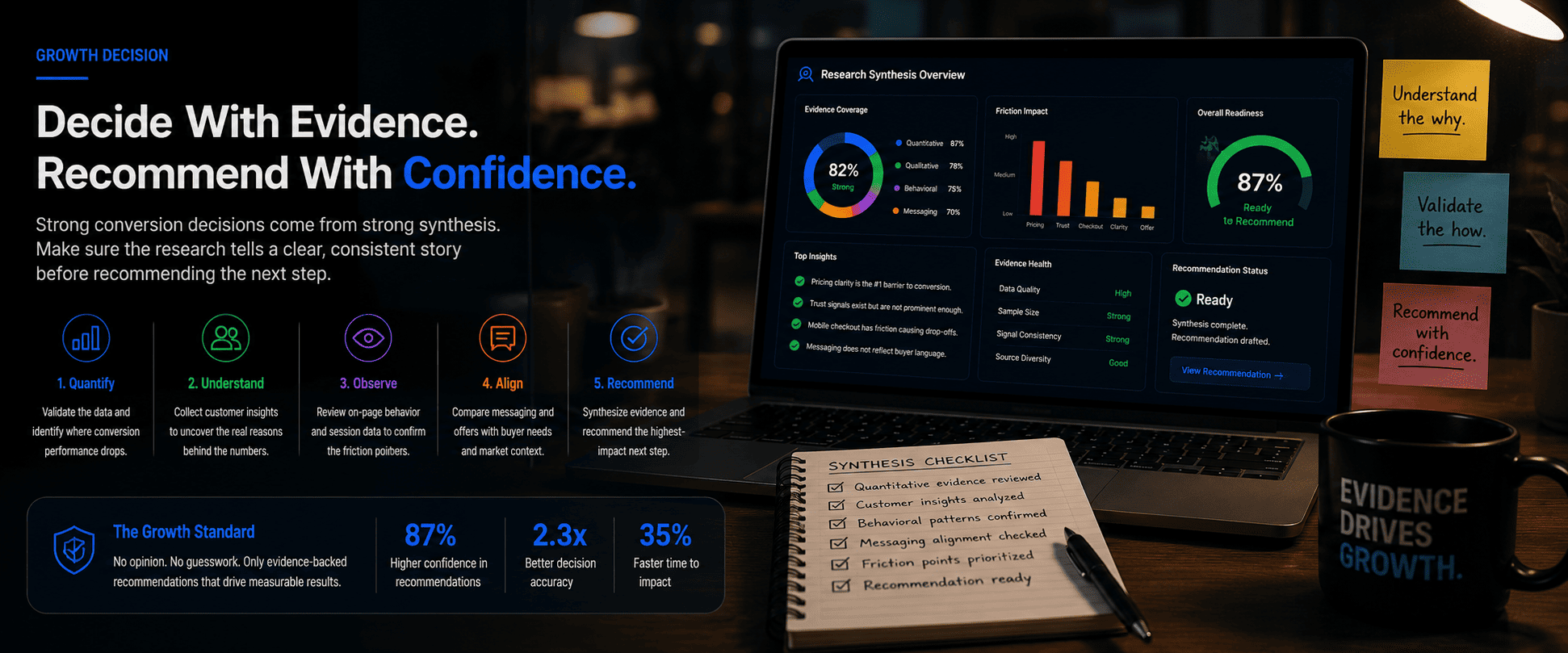
Conversion Optimization Research Synthesis Review
Conversion teams often have more evidence than they can easily interpret. Web analytics, survey responses, customer research, user testing notes, heatmaps, message-mining workspaces, and experiment logs may all point to different parts of the funnel. The challenge is deciding whether those signals explain the likely friction clearly enough to support a recommendation.
The Conversion Optimization Research Synthesis Review helps teams decide whether conversion research has enough quantitative, qualitative, behavioral, and message evidence before changing a page, offer, or experiment decision. The goal is not to summarize every source. The goal is to turn evidence into a caveated recommendation that a reviewer can approve, hold, or send back for more evidence.
This matters because conversion recommendations can move quickly. A team may want to rewrite messaging, redesign a page section, adjust an offer, or launch a test based on one strong-looking signal. Without synthesis, that signal can be overread. A metric may show where users drop, but not why. A customer quote may reveal a real objection, but only for one segment. A session recording may show friction, but not enough frequency to justify a major change.
What This Workflow Decides
The workflow answers one practical question: is the research strong enough to explain the likely conversion friction before a recommendation is drafted? A useful synthesis should label the finding as strong, limited, or not ready based on evidence coverage and contradiction risk.
- Approve: Quantitative, qualitative, behavioral, and message evidence support the same likely friction.
- Hold: Evidence is promising, but a missing source or contradiction could change the recommendation.
- Send back for evidence: The team needs more analytics, customer research, session review, or message-mining context.
- Keep caveated: The finding is useful, but not strong enough to become an implementation task.
Start With The Conversion Question
Every synthesis review should begin with a specific decision question. The team should not start by collecting broad insights. It should define the conversion problem it needs to explain.
Defining the question keeps the synthesis tied to the page, offer, or experiment decision. It also helps the reviewer avoid using unrelated research to justify a recommendation that the evidence does not actually support.
- Why are paid visitors leaving before CTA click?
- Why is mobile checkout completion dropping?
- Should the pricing page message be updated?
- Which friction point should enter the experiment backlog first?
- Is trust, clarity, effort, or offer fit the likely barrier?
Map Each Finding To Evidence Sources
A conversion finding should be mapped to at least one observed source and one supporting context source. Observed sources show what users did. Context sources help explain why that behavior may be happening.
This structure prevents the team from treating a single signal as complete proof. A finding becomes stronger when behavior, customer language, and page context all point toward the same friction mechanism.
- Observed source: Google Analytics, heatmaps, session recordings, funnel reports, user testing behavior, or experiment results.
- Context source: Customer research, survey answers, sales notes, support themes, message-mining notes, or buyer language.
- Decision source: Optimization review log, recommendation status, owner note, or approval record.
Review Quantitative Signals
Quantitative evidence helps identify where the conversion path breaks. Web analytics and funnel data can show whether the issue appears at the landing page, CTA, form, checkout, product page, or post-click path.
The reviewer should use these signals to locate the friction, not to explain it fully. A drop in CTA clicks may suggest message or trust friction, but it needs supporting evidence before the team changes the page.
- Landing page conversion rate
- CTA click-through rate
- Form completion or checkout completion
- Revenue per visitor
- Device and traffic-source breakdowns
- Stage-by-stage funnel movement
- Experiment result reports
Translate Customer Language Into Friction
Customer research gives meaning to the numbers. Survey responses, interviews, support notes, sales conversations, and message-mining workspaces help the team understand what buyers are thinking, questioning, or resisting.
The reviewer should translate raw customer language into a useful category: objection, desired outcome, proof need, confusion, risk concern, price concern, or next-step uncertainty.
If customer language is thin or mismatched to the current audience, the recommendation should stay caveated.
- What questions appear repeatedly?
- Which objections delay commitment?
- What outcome does the buyer want most?
- Where does the current message feel unclear?
- What proof would reduce hesitation?
Validate Behavioral Friction Carefully
Behavioral evidence helps confirm whether users act in ways that match the research interpretation. Session recordings, heatmaps, user testing notes, repeated clicks, scroll patterns, navigation loops, and abandonment behavior can all reveal friction.
The key is not to overstate causality. A user hovering near pricing may indicate confusion, comparison behavior, or normal decision-making. A long scroll may show engagement, or it may show that users cannot find the answer they need. The synthesis should connect observed behavior to a plausible friction mechanism without pretending the behavior proves more than it does.
- Where do users hesitate or exit?
- Does the same behavior repeat across sessions?
- Does the behavior match customer research?
- Does the page message explain or contradict the pattern?
- What evidence would weaken this interpretation?
Compare The Message And Offer
After reviewing analytics, research, and behavior, compare the findings with the live page or offer. The page should address the buyer problem, desired outcome, proof need, and objection that the evidence reveals.
If the page creates curiosity without resolving trust, fit, or effort objections, the team should not recommend more traffic as the first fix.
- Does the headline match the buyer’s actual concern?
- Does the offer explain value clearly enough?
- Is proof placed where hesitation appears?
- Does the CTA match the buyer’s readiness?
- Does the page create belief before asking for action?
Document Contradictions And Revenue Caveats
Not every synthesis will produce a clean answer. Analytics may show weak conversion while research suggests high clarity. Heatmaps may show engagement while sales calls reveal unresolved objections. Revenue movement may look positive while payment timing or customer quality is unclear.
Revenue-informed findings should stay caveated when cash timing, order quality, or durable customer value is missing.
- Confirmed signals
- Contradictory signals
- Missing evidence
- Customer segments needing review
- Commerce or payment caveats
- Recommendation confidence: strong, limited, or not ready
Final Approval Rule
A Conversion Optimization Research Synthesis Review should end with a clear approve, hold, or send-back decision. Approve only when the research explains the likely friction with enough source coverage, customer-language clarity, behavioral support, and message alignment.
If evidence is incomplete or contradictory, keep the recommendation held. 10X can draft the synthesis and next-step recommendation, but execution should remain approval-gated until the reviewer accepts the finding, caveat, owner, and next action.
Sample review note
10X should review Conversion Optimization Research Synthesis Review, compare the decision evidence with the caveats, and keep the next recommendation approval-gated until the reviewer accepts it.