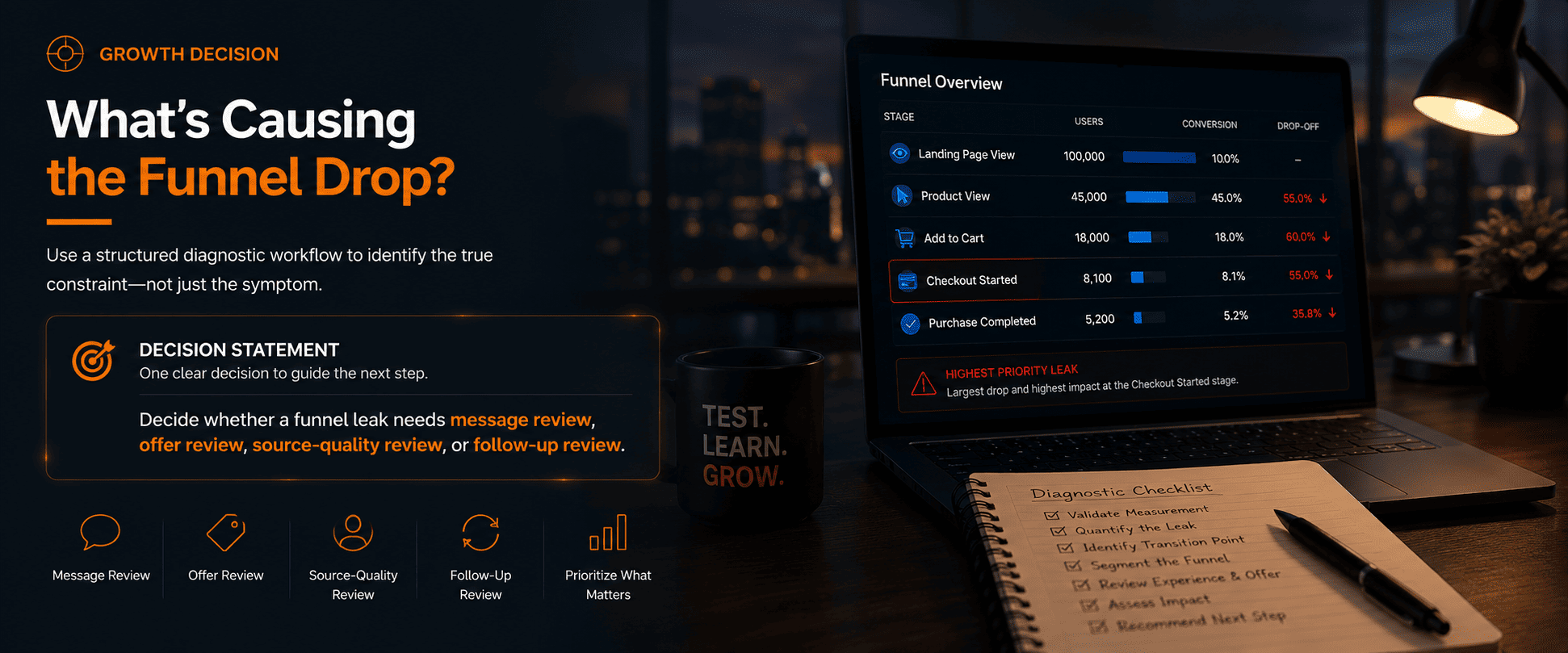
Funnel Leak Diagnosis
Growth teams frequently identify drops between funnel stages and immediately assume a conversion problem exists. In reality, not every decline between stages represents a genuine leak. Some drops are expected customer behavior, some are caused by measurement issues, and others indicate real friction that deserves prioritization. Funnel Leak Diagnosis is the process of determining whether visible conversion loss reflects a true growth constraint and identifying the highest-impact point for investigation.
The objective is not simply to locate where users leave the funnel. The objective is to understand why the loss occurs, whether the signal is trustworthy, and whether fixing the issue would create meaningful business impact. Without a structured diagnostic process, teams often optimize the wrong stage, misinterpret healthy funnel behavior, or spend resources solving measurement problems instead of customer problems.
Why Funnel Leak Diagnosis Matters
Every acquisition channel, landing page, lead flow, checkout process, and lifecycle journey contains some degree of natural drop-off. Customers abandon sessions, delay decisions, compare alternatives, and leave before completing an action. The challenge for growth teams is determining whether observed losses fall within expected behavior or indicate a significant opportunity.
A disciplined diagnostic workflow prevents organizations from reacting emotionally to conversion declines and instead focuses attention on evidence-backed constraints that influence revenue, lead generation, retention, or customer acquisition efficiency.
Understanding Funnel Stages
Most funnels contain a sequence of customer actions that move a prospect closer to conversion. Depending on the business model, stages may include impressions, clicks, landing page visits, lead submissions, qualification reviews, checkout events, purchases, onboarding milestones, or subscription renewals.
Each stage represents a customer commitment point. Funnel analysis becomes valuable when teams evaluate how efficiently users move from one stage to the next and whether conversion patterns remain consistent over time.
Step 1: Validate Measurement Integrity
Before investigating customer behavior, teams must verify that the underlying data is trustworthy. Tracking failures frequently create the appearance of funnel leakage even when customer behavior has not changed.
Diagnostic reviews should validate event collection, conversion tracking, attribution logic, CRM synchronization, duplicate records, platform integrations, and reporting consistency. If measurement integrity cannot be confirmed, all subsequent conclusions become unreliable.
Step 2: Quantify the Size of the Leak
Not every conversion decline deserves immediate attention. The next step is determining the magnitude of the observed loss and its potential business impact.
A small percentage decline in a low-volume funnel stage may have little revenue consequence. A similar decline in a high-volume stage could create significant revenue exposure. Quantifying impact helps prioritize investigation efforts.
Step 3: Identify the Exact Transition Point
Broad funnel reports often hide the location of actual friction. Effective diagnosis requires isolating the specific stage transition where performance deteriorates.
For example, an ecommerce funnel may appear healthy through product views and add-to-cart events but show substantial loss during checkout initiation. A lead generation funnel may demonstrate strong form completion but weak sales qualification rates. Identifying the exact transition point improves diagnostic precision.
Step 4: Compare Historical Performance
Historical context is essential. Funnel stages rarely maintain identical conversion rates across every period. Seasonal behavior, campaign changes, audience shifts, pricing updates, competitive activity, and product changes can influence outcomes.
Comparing current performance against historical baselines helps determine whether observed behavior represents a new problem or a normal operating pattern.
Step 5: Segment the Funnel
Aggregate reporting often conceals the real source of performance issues. Funnel leak diagnosis should segment data by traffic source, device type, geography, audience cohort, campaign, landing page, customer type, and acquisition channel.
Segmentation frequently reveals that apparent funnel leakage is concentrated within a specific audience or traffic source rather than affecting the entire customer journey.
Step 6: Evaluate Traffic Quality
Many funnel leaks originate before customers enter the affected stage. Poor targeting, low-intent traffic, misleading ad messaging, or irrelevant audience acquisition can introduce users who were never likely to convert.
Traffic quality reviews help determine whether the leak reflects genuine funnel friction or weak acquisition quality entering the system.
Step 7: Review Customer Experience Friction
Once measurement and traffic quality have been validated, teams should investigate customer experience barriers. Friction can occur through slow page performance, confusing navigation, poor mobile usability, excessive form requirements, weak messaging, unclear value propositions, or checkout complexity.
Customer experience reviews help identify obstacles that prevent users from progressing naturally through the funnel.
Step 8: Examine Offer and Economics Alignment
Conversion challenges are not always caused by design or usability issues. Pricing, packaging, qualification criteria, shipping costs, contract requirements, and perceived value frequently influence progression rates.
Customers may understand the journey perfectly yet decide the offer does not justify continued commitment. Diagnosing economic friction is therefore an important component of leak analysis.
Step 9: Assess Operational Constraints
Some funnel leaks originate within business operations rather than customer-facing experiences. Sales response delays, inventory limitations, onboarding bottlenecks, approval processes, fulfillment constraints, and support capacity issues can reduce progression rates even when acquisition and conversion systems perform effectively.
Operational reviews help determine whether internal processes contribute to observed leakage.
Step 10: Estimate Business Impact
Not every leak warrants immediate remediation. Teams should estimate the potential impact associated with improving the affected stage. Opportunity sizing includes evaluating incremental leads, conversions, revenue, profitability, customer retention, and operational requirements.
This step ensures that optimization efforts focus on the most valuable constraints rather than the most visible ones.
Common Causes of Funnel Leakage
Recurring causes of funnel leakage include tracking failures, low-quality traffic acquisition, weak landing page alignment, form abandonment, checkout friction, pricing resistance, poor qualification processes, delayed follow-up, audience mismatch, technical issues, and attribution inconsistencies. Identifying the correct cause is more important than identifying the stage where leakage occurs.
When a Funnel Leak Is Not a Problem
Growth teams sometimes treat every conversion decline as a crisis. In reality, healthy funnels contain natural attrition. Certain audiences require longer consideration periods. Some campaigns intentionally prioritize scale over efficiency. Some qualification processes intentionally reduce conversion rates to improve downstream quality.
A strong diagnostic process recognizes the difference between expected tradeoffs and genuine performance constraints.
Building an Evidence-Based Recommendation
The final outcome of a Funnel Leak Diagnosis should be a bounded recommendation. Teams should clearly state whether the evidence supports immediate action, further investigation, ongoing monitoring, or no intervention. Recommendations should identify supporting evidence, known caveats, confidence levels, and expected business impact.
Strong recommendations avoid overstating certainty. When evidence remains incomplete, the appropriate next step may be additional measurement or validation rather than optimization.