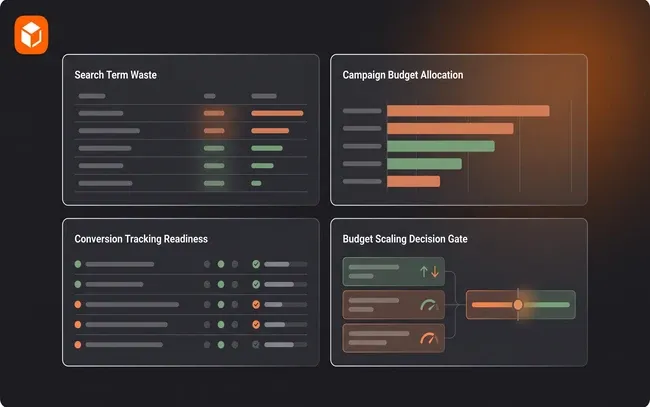
How to read this workflow
A growth lead is about to expand search campaigns, change match types, or add negative keywords and needs to confirm that search term spend is actually being wasted before acting. This diagnostic applies when budget is under pressure, cost-per-acquisition is rising without clear cause, or the team suspects broad-match queries are pulling in irrelevant traffic. The stakes: making targeting changes without isolating the real constraint can cut qualified volume alongside waste, or worse, mask a landing page problem as a campaign problem.
Budget Pressure and Spend Quality
Rising spend does not automatically mean waste. Budget pressure can originate from increased auction competition, bid strategy targets being too aggressive, genuine volume growth on qualified terms, or missing business context that explains why spend moved.
What to check:
Decision rule: If budget movement is not supported by quality or efficiency context, draft a review note rather than an account change -- because premature budget cuts can starve campaigns that are actually scaling well, and the lost volume is hard to recover.
- Is spend pacing ahead of plan, and if so, is conversion volume keeping pace?
- Is the efficiency target (target CPA or ROAS) still being met despite higher spend?
- Are bid constraints (caps, portfolio limits) forcing impressions into lower-quality auctions?
- Is there a business context event (seasonal demand, product launch) that explains the movement?
Scaling Signal Quality
When search volume increases, the team needs to know whether that growth represents genuine demand or platform-driven expansion into lower-intent queries. A real scale signal shows sustained volume at stable or improving efficiency with downstream quality holding.
What to check:
Decision rule: If volume or quality is not strong enough, keep the recommendation as a staged review rather than a scale action -- because scaling on a weak signal locks in higher spend before the evidence supports it, and reversing a scale decision mid-flight disrupts bidding algorithms.
- Has spend increased alongside proportional result volume, or is volume flat while spend rises?
- Are efficiency metrics (CPA, ROAS) stable over a meaningful window (7-14 days minimum)?
- Is there any frequency or fatigue signal suggesting the same users are being reached repeatedly?
- Does downstream quality (lead score, pipeline value) confirm the new volume is qualified?
Landing Page and Post-Click Cost Context
A rising cost-per-click or cost-per-conversion is often blamed on the campaign when the actual bottleneck sits downstream. If the ad promises something the landing page does not deliver, conversion rates drop and effective CPA rises regardless of targeting quality.
What to check:
Decision rule: If the post-click path is the likely constraint, draft the page or offer review before changing campaign settings -- because adding negatives or tightening match types will reduce volume without fixing the conversion bottleneck, leaving the account smaller and still inefficient.
- Does the ad's creative promise match the landing page headline and offer?
- Has page conversion rate moved independently of traffic quality changes?
- Is there offer friction (form length, pricing visibility, unclear CTA) that could explain drop-off?
- Are click costs rising due to auction dynamics, or is the real issue fewer conversions per click?
Conversion Quality and Measurement Confidence
Not every conversion event carries equal decision weight. A form submission tracked as a conversion may be a spam fill, a duplicate, or a low-intent download. The recommendation changes depending on whether the tracked event actually represents the business outcome.
What to check:
Decision rule: If conversion quality is unknown, keep the recommendation caveated until the downstream source is reviewed -- because acting on inflated or misattributed conversion data leads to protecting terms that produce volume without value, which is the opposite of waste reduction.
- Is the primary conversion action aligned with the business decision (revenue, qualified pipeline)?
- Are diagnostic events (page views, scroll depth) being conflated with decision-driving conversions?
- Does the attribution model introduce caveats (long windows, cross-device gaps, view-through inflation)?
- Is there a downstream quality source (CRM stage, revenue data) that validates platform-reported conversions?
Review checklist
Use these checks to keep the recommendation approval-gated before the team changes the page, campaign, workflow, or reporting setup.
- Budget pressure cause identified (volume, quality, bid, or missing context)
- Scale signal validated with efficiency and downstream quality
- Post-click path reviewed before blaming campaign targeting
- Conversion events separated into decision-driving vs. diagnostic
- Attribution caveats named explicitly
- At least one supporting input confirms the primary finding
- Missing inputs flagged with hold status
- Recommendation labeled as strong, caveated, or not ready
- Follow-up action is approval-gated, not auto-executed
Worked Example
A B2B SaaS team sees search CPA rise 40% month-over-month. The initial read is that broad match terms are pulling in irrelevant traffic and the fix is to add 200 negative keywords.
Budget pressure is real, but conversion volume also increased 25%. The efficiency decline is concentrated on three landing pages where bounce rate spiked after a recent redesign. Downstream CRM data shows lead quality on search terms is stable. The constraint is post-click, not pre-click.
Draft the landing page review first. Hold the negative keyword list as a staged action pending two-week quality confirmation.
If lead quality degrades over the next two weeks (CRM data lags by 7-10 days), the search term quality hypothesis returns.
Approval boundary
Pass: The diagnostic identifies a clear constraint (budget, targeting, landing page, or measurement), at least one supporting input confirms the finding, and the recommendation includes named caveats. The action is approval-gated with a defined review window. Fail: The finding relies on a single data source without supporting context, the constraint type is assumed rather than observed, conversion quality is unvalidated, or the recommendation would trigger an account change without reviewer sign-off. Any of these conditions means the review stays in draft status until gaps are resolved.
Sample review note
10X should review Google Ads Search Term Waste Diagnostic, compare the decision evidence with the caveats, and keep the next recommendation approval-gated until the reviewer accepts it.