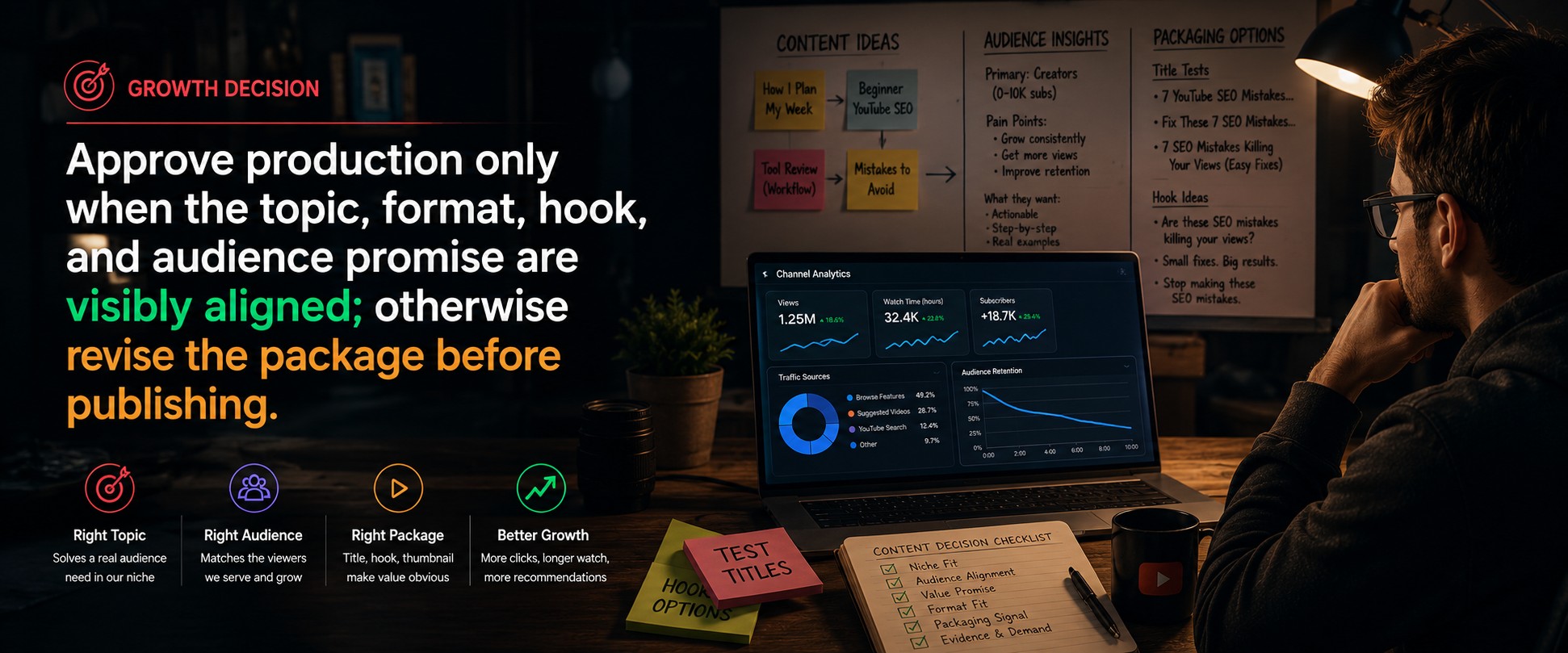
Define What YouTube Niche And Packaging Fit Evaluates
YouTube niche and packaging fit evaluates whether a content idea belongs in the channel's current content lane and whether the title, hook, format, and audience promise make the value clear enough to justify production. The review separates useful topic ideas from ready-to-publish content before the team commits production resources.
A video can be well-produced and still underperform if the topic is too broad, the audience promise is unclear, the format does not match viewer expectation, or the hook fails to make the value obvious. This review reduces that risk before production time is spent and prevents the team from misreading weak packaging as a topic failure.
A decision to move content into production should not be driven by the idea alone. It should be driven by evidence that the niche alignment is confirmed, the audience promise is specific, and the packaging communicates value clearly to the intended viewer.
- Define the content decision before evaluating niche or packaging fit.
- Confirm the content lane the idea is expected to support.
- Separate topic quality from packaging clarity in every evaluation.
- Assign ownership for the next approved content action.
- Document the hold condition if fit is unproven.
Evaluate Channel Niche Fit Before Approving Production
A YouTube channel grows predictably when the audience can understand what the channel is for. When topics are connected by a clear content lane, viewers know what kind of value to expect and the recommendation system receives clearer signals about who is likely to watch, click, and stay.
Weak niche fit creates confusion even when individual videos are useful. The review checks whether the next video reinforces the audience the channel is building or pulls it into an unrelated direction. If the content lane is too broad, increasing cadence amplifies noise rather than growth.
Niche fit should be confirmed before production. A channel publishing scattered topics may produce individually useful videos without building a repeatable audience or a consistent recommendation signal.
- Confirm the topic fits the current YouTube content lane.
- Check whether the idea connects to known channel winners.
- Review audience retention and recommendation patterns for similar topics.
- Identify whether the idea serves the same viewer or a different audience.
- Document niche gaps before approving production resources.
Validate Topic-To-Audience Alignment
A topic can be generally interesting and still be wrong for the channel's specific audience. The review checks whether the topic connects to previous winners, known audience needs, business priorities, or a planned content cluster. The topic should be judged by fit with the channel's viewers, not only by whether it is popular.
If the team cannot explain who the video is for in one sentence, the audience alignment is not yet confirmed. The reviewer should hold the decision until the team clarifies the intended viewer and explains why the topic matters to that audience specifically.
A topic that serves a clear audience produces stronger retention, higher recommendation traffic, and more consistent performance data. An idea without a defined viewer should stay held until the audience promise is clarified.
- Identify the intended viewer for the content idea.
- Confirm the topic addresses a known audience problem or need.
- Check whether YouTube analytics show audience demand for this topic type.
- Review operator notes for qualitative audience context.
- Document audience alignment gaps before approving production.
Review Format Fit For Viewer Expectation
The format determines how the topic is delivered. A strong format matches the viewer's expected depth, pace, and structure. Some topics need a tutorial, while others need a teardown, comparison, explainer, checklist, case study, or opinion-led analysis.
If the format is wrong, the content may attract the right audience but fail to hold attention. A strategic topic delivered as a fast-tips video may feel shallow. A tactical topic delivered as a long conceptual essay may feel slow. The review checks whether the format helps the audience receive the promised value as quickly and clearly as possible.
Format fit should be confirmed alongside topic fit. A strong topic delivered in the wrong format can produce weak retention and misleading performance signals that cause the team to abandon a useful idea unnecessarily.
- Confirm the format matches viewer expectation for the topic type.
- Check whether similar successful videos use a comparable format.
- Evaluate whether the depth and pace suit the intended audience.
- Review whether the format supports the audience promise.
- Document format mismatches before approving production.
Assess Hook Clarity And Urgency
The hook should make the viewer feel the video understands their problem. It should not simply introduce the topic. It should create a reason to keep watching by calling out a mistake, revealing a gap, framing a decision, showing a consequence, or promising a useful outcome.
The review checks whether the hook would appeal to the intended audience specifically. If the hook would attract a different viewer than the channel is trying to serve, the packaging needs revision. A weak hook explains what the video is about; a strong hook explains why the viewer should care right now.
Hook fit should be evaluated independently from topic quality. A useful topic with a weak hook may underperform, and the team may incorrectly conclude the topic was wrong rather than the opening was unclear.
- Confirm the hook addresses a specific viewer problem or question.
- Check whether the hook creates urgency to continue watching.
- Evaluate whether the hook matches the intended audience profile.
- Review retention drop-off patterns for similar hook types.
- Document hook gaps before approving production.
Inspect Title And Thumbnail Promise
The title and thumbnail together form the audience promise. They tell the viewer what outcome to expect from watching. The title should communicate a specific value, not just describe the subject. The thumbnail should support the title rather than repeating it or making an unrelated claim.
Good packaging does not mean making the title louder or more dramatic. It means making the promise easier to understand. The viewer should be able to quickly answer: is this for me, what problem does it solve, and why should I watch it now.
Title and thumbnail fit should be confirmed before content is published. A weak promise suppresses click-through regardless of topic quality, and an inaccurate promise damages viewer trust after the content is watched.
- Confirm the title communicates a specific value promise.
- Check whether the thumbnail direction supports the title promise.
- Evaluate whether the viewer can identify the content's purpose immediately.
- Review whether the promise matches what the video actually delivers.
- Document title and thumbnail gaps before approving publication.
Verify Audience Promise Specificity
The audience promise is the outcome the viewer expects from watching the video. It should be specific enough to create interest and accurate enough to avoid misleading. A strong audience promise tells the viewer what they will understand, decide, fix, compare, avoid, or improve by watching.
If the audience promise is vague, the reviewer should not approve production. The team should rewrite the title, hook, or angle until the promise is clear. A specific promise also makes performance data easier to interpret: if the video succeeds, the team knows what resonated, and if it underperforms, the team knows which promise did not connect.
A specific audience promise protects both the viewer and the team. The viewer knows what they will gain, and the team has a clear benchmark for evaluating whether the content succeeded.
- Confirm the audience promise is specific and measurable.
- Check whether the promise aligns with viewer intent for the topic.
- Evaluate whether the video delivers on the stated promise.
- Review whether the promise distinguishes the video from alternatives.
- Document promise gaps before approving production.
Keep Packaging Caveats Visible During Review
Decision-makers should see packaging limitations alongside packaging findings. Caveats around niche fit uncertainty, audience alignment assumptions, format mismatch risk, hook weakness, and title clarity gaps should remain attached to the recommendation throughout the review process.
Burying caveats creates a false impression of packaging readiness. Each finding should carry its limitation so the reviewer can weigh confidence alongside the evidence. A visible caveat prevents the workflow from turning into automatic approval when the team is under pressure to publish.
Visible caveats improve trust by helping stakeholders understand the limitations behind the packaging evidence. The review should not approve production when significant caveats remain unresolved.
- Document which packaging signals are incomplete or unverified.
- Surface niche fit assumptions that could change the recommendation.
- Highlight format mismatches that weaken the audience promise.
- Make hook and title caveats explicit before approving production.
- Separate confidence from certainty in every packaging finding.
Approval-Gated Packaging Reviews Protect Content Quality
Niche and packaging fit checks carry production resource cost and audience relationship risk. An approval-gated review ensures the team does not confuse a useful idea with a ready-to-publish asset when deciding whether to move content into production or commit repurposing resources.
The reviewer should approve only the next step supported by visible niche and packaging evidence. If topic fit, audience alignment, format match, hook clarity, or title promise evidence is not visible, the output should be a hold or revision note rather than a production approval.
Approval gating protects content teams from publishing based on idea enthusiasm when the underlying niche alignment and packaging clarity remain unproven. The review should answer a clear decision: approve, revise, or hold until the audience promise is clear and the evidence supports it.
- Assign an owner for the next approved content action.
- Document reviewer acceptance of the packaging evidence and caveats.
- Track approval state before production or repurposing begins.
- Identify unresolved packaging dependencies that could block success.
- Keep follow-up actions visible until packaging evidence improves.
Sample review note
10X should review YouTube Niche and Packaging Fit, compare the decision evidence with the caveats, and keep the next recommendation approval-gated until the reviewer accepts it.