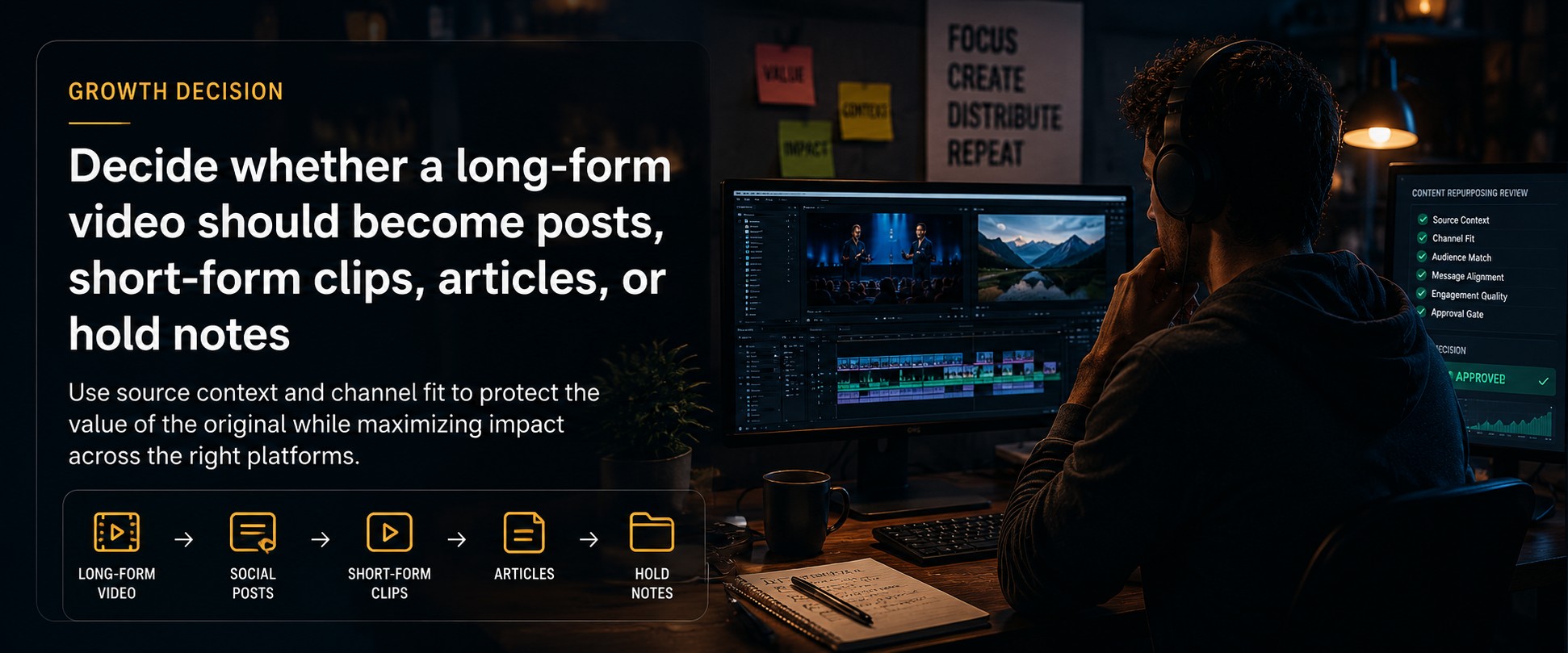
Why Video Repurposing Requires a Review Process
Repurposing content sounds simple in theory. A team records a webinar, uploads it to YouTube, and extracts clips for LinkedIn, Instagram, or other platforms. However, successful repurposing involves far more than cutting a video into smaller pieces.
Each platform serves a different audience, content format, and user expectation. What works in a 45-minute educational video may fail completely as a 30-second social clip if the key context is removed.
The purpose of a Video to Social Repurposing Review is to answer one critical question:
Should this content be repurposed, and if so, what format will preserve its value while maximizing platform relevance?
The review ensures that every derivative asset maintains the original insight, proof, and intent while adapting appropriately to the target channel.
The Core Decision: Approve, Hold, or Request More Evidence
Every review should end with one of three outcomes:
This decision framework prevents teams from flooding channels with content that appears active but delivers little business value.
- Approve: The content contains valuable insights and sufficient evidence for repurposing.
- Hold: Important context is missing, making repurposing risky.
- Request Additional Evidence: The content may have potential, but supporting data or clarification is required.
Understanding the Source Context
Before creating any derivative asset, reviewers should understand where the content originated and why it was created.
Common source platforms include:
The original purpose of the content often determines whether repurposing makes sense.
For example, a customer success interview may contain strong proof points suitable for LinkedIn content, while a technical training session may be better transformed into an educational article rather than short-form social clips.
- YouTube videos
- Webinars
- Google Drive recordings
- Customer interviews
- Internal training sessions
- Product demonstrations
- Sales presentations
- Podcast episodes
Evaluating Platform Fit
One of the most common repurposing mistakes occurs when teams ignore platform behavior.
Each channel rewards different content characteristics:
During the review process, teams should assess whether the original content naturally aligns with the target platform.
- Professional insights
- Industry analysis
- Case studies
- Business lessons
- Visual storytelling
- Short educational content
- High engagement formats
- Quick takeaways
- Attention-grabbing moments
- Standalone educational clips
Preserving Context During Repurposing
A critical review checkpoint involves context preservation.
Many repurposed assets fail because they remove the information that made the original content useful.
For example, a webinar speaker might present a recommendation based on specific market conditions. Extracting only the recommendation without the supporting explanation may create a misleading social post.
Reviewers should verify that every derivative asset answers:
If these elements cannot be retained, the asset should remain in draft status.
- What is being discussed?
- Why does it matter?
- What evidence supports the claim?
- What action should the audience take?
Creative Message Alignment
Strong content succeeds because the message aligns with audience needs.
Repurposing should never focus solely on format conversion. Instead, teams should evaluate whether the core message remains relevant to the target audience.
Questions to ask include:
If the audience-message fit is unclear, repurposing should be paused until clarification is available.
- Which audience belief is this content intended to influence?
- What problem does it solve?
- What proof supports the recommendation?
- Does the message match audience expectations on the destination platform?
Social Signal Qualification
Many organizations repurpose content solely because a video received views, likes, or comments.
This can lead to poor decisions.
Engagement metrics alone do not prove content quality.
Reviewers should determine:
Only qualified engagement should justify further content investment.
- Who engaged with the content?
- Were they part of the target audience?
- Did engagement indicate genuine interest?
- Did the content influence business outcomes?
Common Failure Modes
The review process should actively identify common mistakes.
The original insight disappears, leaving behind generic social content that provides little value.
Important limitations from the source material are removed, creating overly confident recommendations.
Content moves directly into production before stakeholders verify assumptions.
The asset is technically correct but mismatched to audience expectations.
The Importance of Approval-Gated Execution
Even when a review identifies a strong repurposing opportunity, execution should remain approval-gated.
This means recommendations can be drafted automatically, but publishing decisions should require human review.
Approval gates reduce risk by ensuring:
This approach balances operational efficiency with strategic quality control.
- Context remains accurate
- Claims are verified
- Brand messaging stays consistent
- Platform fit is confirmed
What a Successful Repurposing Review Looks Like
A successful review produces a clear recommendation supported by visible evidence.
The reviewer should understand:
If any of these elements are unclear, the output should remain a hold note rather than an approval.
- Why the content deserves repurposing
- Which platform is most appropriate
- What format should be created
- What risks remain visible
- Who owns the next action
Final Thoughts
Video content contains tremendous hidden value, but successful repurposing requires more than content recycling. Organizations must evaluate source context, platform fit, audience alignment, evidence quality, and execution risks before transforming a long-form asset into multiple content formats.
A structured Video to Social Repurposing Review ensures that every derivative asset preserves the original insight while maximizing effectiveness on the destination channel. Instead of creating more content, teams create better content—content that remains useful, trustworthy, and strategically aligned with business goals.
The goal of repurposing is not to create more content. The goal is to extend the value of valuable content without losing the context that made it useful in the first place.
Sample review note
10X should review Video to Social Repurposing Review, compare the decision evidence with the caveats, and keep the next recommendation approval-gated until the reviewer accepts it.