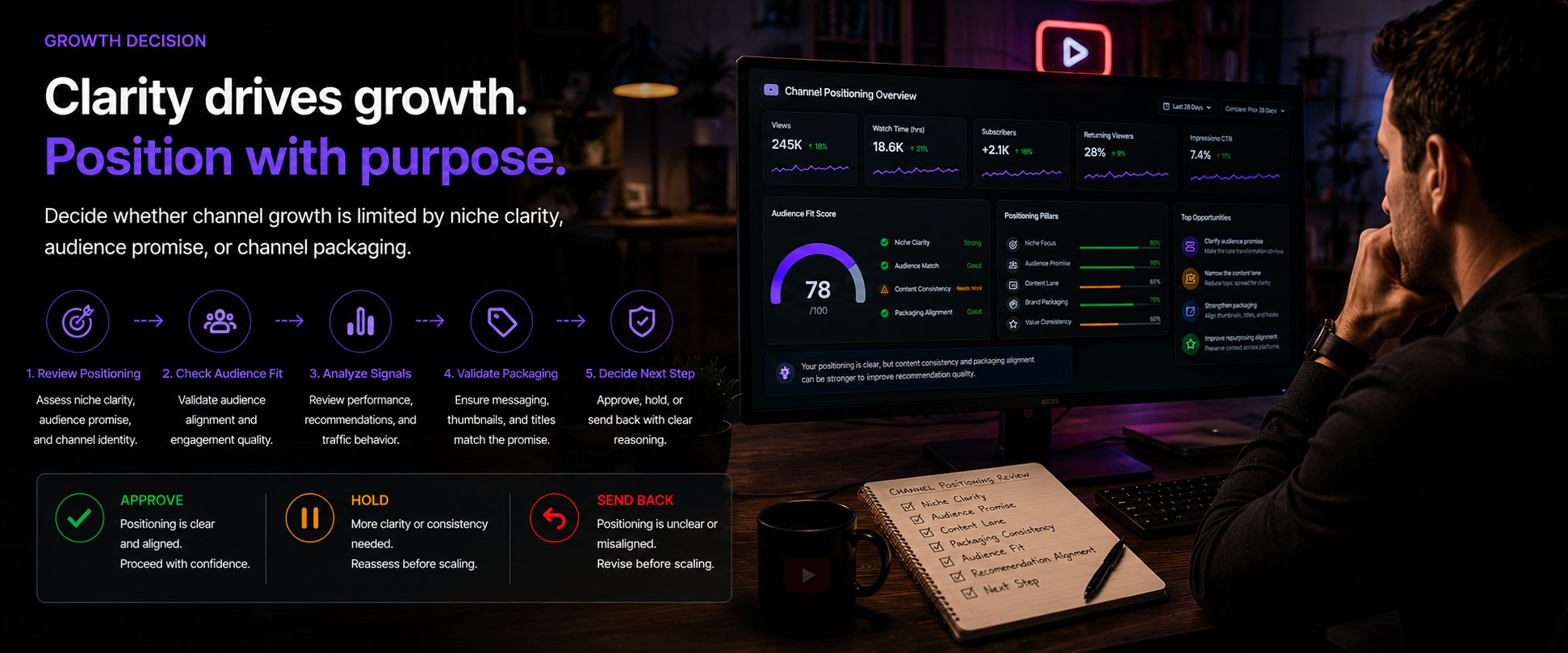
Why YouTube channel positioning reviews matter
YouTube growth problems are often blamed on algorithms, publishing frequency, or production quality. But many channels fail to grow because the positioning itself is unclear.
A viewer should immediately understand who the channel is for, what kind of transformation or insight it provides, and why the next video matters. When that audience promise is weak, even strong content can struggle to create subscriber momentum, recommendation consistency, or repeat viewing behavior.
The YouTube Channel Positioning Review exists to help growth teams evaluate whether niche clarity, audience promise, packaging consistency, and channel identity are strong enough before increasing production volume or expanding distribution.
This workflow is designed to produce a reviewable growth decision instead of generic branding advice. The reviewer should identify what supports growth, what weakens audience understanding, what remains uncertain, and what should stay approval-gated.
What this workflow helps decide
The review helps determine whether the team should:
The reviewer should not simply approve "more content." The workflow should identify whether the audience and recommendation system can clearly understand what the channel represents.
- Narrow the channel niche
- Clarify the audience promise
- Improve thumbnail and title consistency
- Adjust content positioning
- Change publishing direction
- Improve repurposing alignment
- Hold expansion plans until positioning improves
- Restructure the content lane before scaling production
Inputs required for the review
YouTube: CTR, retention, returning viewers, subscriber conversion, topic clustering, recommendation behavior, and engagement quality. Google Analytics: Referral traffic quality, audience paths, session depth, landing-page movement, and conversion alignment. Google Sheets: Topic tracking, positioning comparisons, audience segmentation, publishing calendars, and packaging reviews.
CRM: Audience qualification signals, lead quality, customer overlap, and business-aligned segment analysis. Operator Notes: Strategic context around audience assumptions, positioning experiments, publishing concerns, and channel direction.
- YouTube: CTR, retention, returning viewers, subscriber conversion, topic clustering, recommendation behavior, and engagement quality.
- Google Analytics: Referral traffic quality, audience paths, session depth, landing-page movement, and conversion alignment.
- Google Sheets: Topic tracking, positioning comparisons, audience segmentation, publishing calendars, and packaging reviews.
- CRM: Audience qualification signals, lead quality, customer overlap, and business-aligned segment analysis.
- Operator Notes: Strategic context around audience assumptions, positioning experiments, publishing concerns, and channel direction.
Step 1: Review niche clarity
The first step is determining whether the channel niche is clear enough for viewers and the recommendation system to understand what the next upload is likely to deliver. This check determines whether the channel is focused enough for the audience and recommendation system to understand what the next video is for.
Many channels weaken growth by publishing across too many unrelated topics. Even when individual videos perform reasonably well, the overall channel identity becomes difficult to interpret.
The reviewer should evaluate:
If viewers cannot predict what value the next video provides, subscriber loyalty and recommendation quality often weaken over time.
- Topic consistency
- Audience overlap between videos
- Recommendation alignment
- Subscriber expectation clarity
- Content-lane stability
Step 2: Evaluate the audience promise
A strong YouTube channel communicates a clear audience promise. The viewer should understand:
Weak audience promises often create high bounce rates, inconsistent watch behavior, and unstable subscriber growth.
The reviewer should inspect whether the channel positioning clearly communicates:
This check confirms whether the channel makes the audience promise clear enough for the next content decision. If the promise is too broad or vague, the positioning should remain under review before expanding production.
- Who the channel is for
- What type of insight or transformation it delivers
- Why the content matters
- What problem it helps solve
- Desired outcome
- Audience identity
- Problem focus
- Strategic content lane
Step 3: Review packaging consistency
Packaging includes thumbnails, titles, hooks, visual identity, and topic framing.
Strong packaging helps the audience instantly recognize:
The reviewer should inspect:
If packaging varies too aggressively across uploads, audience understanding weakens even when the production quality is strong.
- What type of value the content provides
- Why the topic matters now
- Whether the video fits the channel promise
- Thumbnail consistency
- Headline structure
- Visual identity
- Topic framing
- Brand clarity
- Hook quality
Step 4: Check recommendation-system alignment
The YouTube recommendation system performs better when it can consistently identify audience patterns and content relationships.
The reviewer should evaluate:
If the recommendation system receives mixed audience signals because the positioning is inconsistent, growth efficiency may weaken over time.
- Suggested-video overlap
- Topic relationship stability
- Audience retention consistency
- Subscriber return behavior
- Topic clustering strength
Step 5: Review audience qualification quality
Not all engagement signals represent meaningful audience alignment. This check determines whether social engagement is qualified enough to support follow-up.
A channel may generate views or social engagement while still attracting low-intent or poorly aligned audiences.
The reviewer should distinguish:
If audience quality is unclear, the recommendation should remain partially held until additional evidence exists.
- Qualified engagement
- Curiosity clicks
- High-retention viewers
- Low-intent traffic
- Subscriber-quality consistency
Step 6: Review repurposing alignment
Repurposing should strengthen the channel promise rather than dilute it. This check reviews whether repurposed assets preserve the original context while fitting the channel where they will be used.
Many channels weaken positioning by turning highly contextual videos into generic clips that lose the original insight or strategic focus.
The reviewer should inspect:
If repurposing weakens the channel identity, the workflow should hold the action until the asset is revised.
- Whether the repurposed asset preserves context
- Whether the asset still supports the audience promise
- Whether platform formatting weakens the original message
- Whether the repurposed content creates positioning confusion
Step 7: Map the creative message to audience beliefs
Positioning becomes stronger when the creative message aligns with audience beliefs, frustrations, aspirations, or objections. This check maps the creative message to the buyer belief or objection it is supposed to move.
The reviewer should identify:
If the content message does not consistently reinforce a recognizable audience identity, positioning instability often follows.
- Which audience frustration the content addresses
- Which desired outcome the channel reinforces
- Which belief the content challenges or supports
- Which audience stage the channel primarily serves
Step 8: Separate positioning problems from production problems
Weak positioning is frequently misdiagnosed as a production-quality problem.
Channels often increase production complexity, improve editing, or publish more frequently when the actual issue is audience confusion or weak channel identity.
The reviewer should distinguish:
If positioning itself remains unclear, scaling production may amplify the wrong audience signals.
- Positioning weakness
- Production inconsistency
- Publishing instability
- Audience mismatch
- Packaging confusion
Step 9: Review whether the channel supports future growth
Positioning decisions affect future scalability.
The reviewer should determine whether the current positioning:
If the positioning is too broad, reactive, or trend-dependent, long-term growth may weaken even if short-term performance spikes occur.
- Supports audience expansion
- Creates repeat viewing behavior
- Builds recognizable authority
- Supports product or business alignment
- Maintains content consistency over time
Step 10: Decide what changes and what stays held
The final recommendation should clearly state:
If audience fit or niche clarity remains uncertain, the recommendation should stay partially held instead of approving aggressive publishing expansion.
10X should review YouTube Channel Positioning Review, compare the decision evidence with the caveats, and keep the next recommendation approval-gated until the reviewer accepts it.
- What positioning issue matters most
- What evidence supports the recommendation
- What uncertainty still exists
- What should change immediately
- What should remain approval-gated
- Who owns the next action if the review is approved, and what stays on hold if it is not
Failure modes this workflow prevents
The diagnostic workflow is treated as generic content instead of a growth decision. The recommendation skips the source caveat, so the next step looks safer than the evidence allows. Follow-up moves forward before the reviewer accepts the approval rule.
Scaling production before fixing positioning confusion Publishing across unrelated content lanes Weakening subscriber trust through inconsistent messaging Repurposing content that loses context Confusing curiosity traffic with qualified audience growth Over-optimizing production while ignoring audience promise clarity Creating packaging inconsistency across uploads Expanding into topics that weaken recommendation-system alignment
- The diagnostic workflow is treated as generic content instead of a growth decision.
- The recommendation skips the source caveat, so the next step looks safer than the evidence allows.
- Follow-up moves forward before the reviewer accepts the approval rule.
- Scaling production before fixing positioning confusion
- Publishing across unrelated content lanes
- Weakening subscriber trust through inconsistent messaging
- Repurposing content that loses context
- Confusing curiosity traffic with qualified audience growth
- Over-optimizing production while ignoring audience promise clarity
- Creating packaging inconsistency across uploads
Recommended decision outcomes
Approve: The channel positioning is clear enough to support the next publishing, packaging, or audience-growth decision. Hold: The evidence is incomplete or audience promise clarity remains unstable. Send back: Niche focus, packaging consistency, audience fit, or positioning clarity require revision before scaling.
- Approve: The channel positioning is clear enough to support the next publishing, packaging, or audience-growth decision.
- Hold: The evidence is incomplete or audience promise clarity remains unstable.
- Send back: Niche focus, packaging consistency, audience fit, or positioning clarity require revision before scaling.
What should remain approval-gated
10X can draft recommendations, positioning reviews, packaging suggestions, repurposing guidance, topic maps, and audience-fit diagnostics. Execution should remain approval-gated.
The system should not automatically change publishing strategy, reposition the channel, expand content lanes, or alter the audience promise until the reviewer accepts the evidence and caveats.