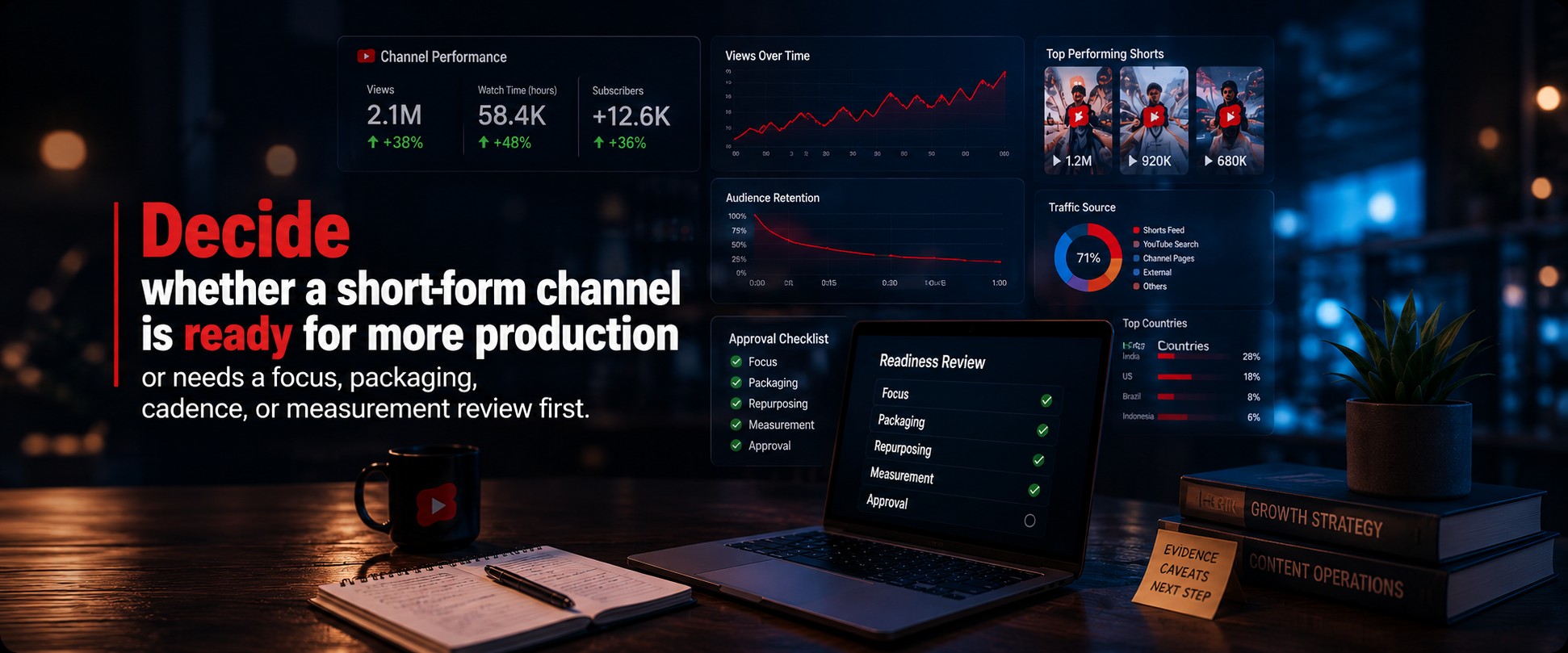
Define What The YouTube Shorts Readiness Review Decides
A YouTube Shorts channel readiness review determines whether a short-form channel has enough focus, packaging clarity, repurposing quality, and measurement visibility to support increased production volume. The review separates channel activity from channel readiness so the team does not scale output before confirming the underlying growth evidence.
The output is a clear approval decision: approve more production, hold the next step, or send the channel back for additional evidence. The review should not treat channel activity as proof of readiness. It should keep visible performance signals tied to evidence rather than momentum.
A decision to increase Shorts production should not be driven by the presence of content alone. It should be driven by evidence that the channel focus, packaging, repurposing quality, and measurement infrastructure can support the scaled output.
- Define the growth decision before reviewing channel performance.
- Identify the specific recommendation under evaluation.
- Separate channel activity from channel readiness.
- Assign ownership for the approval decision.
- Document the hold condition if the review is not approved.
Evaluate Channel Focus Before Increasing Production Volume
Weak YouTube Shorts growth is frequently a focus problem rather than a production-volume problem. When the content lane is too broad, unclear, or disconnected from the current audience, producing more videos rarely solves the underlying constraint.
The readiness review evaluates whether the channel is focused enough for the audience and the recommendation system to understand what the next video is for. A channel covering many unrelated topics should address focus before scaling cadence.
A tightly focused channel gives the audience a clear reason to return and gives the recommendation system a consistent signal to work with. Scaling production on an unfocused channel amplifies the confusion rather than the reach.
- Define the channel content lane before reviewing performance.
- Identify whether the topic breadth supports or dilutes growth.
- Confirm the audience understands what the channel delivers.
- Evaluate whether the recommendation system can classify the content correctly.
- Document focus gaps that could explain weak performance.
Validate Audience Fit Against Content Signals
A YouTube Short can generate views without proving the content is reaching the audience the business actually wants. View count alone does not confirm that the right viewers are engaging, returning, or converting.
The readiness review compares content engagement signals against the target audience profile. If the Shorts are attracting viewers who do not match the intended customer or user base, the channel may look active while building the wrong audience.
Producing more Shorts for the wrong audience accelerates the misalignment rather than fixing it. Audience fit should be confirmed before the team invests more production effort into the channel.
- Define the target audience profile for the channel.
- Compare current viewer demographics against that profile.
- Evaluate engagement signals from the intended audience.
- Identify viewership that does not align with business goals.
- Document audience-fit gaps before increasing cadence.
Review Packaging Clarity Before Publishing
A useful content idea can underperform when the packaging does not clearly signal who the Short is for, why it matters now, or what the viewer will receive. The hook, title, topic signaling, and first-frame impression must communicate value before the viewer scrolls past.
The readiness review evaluates whether the packaging makes the value obvious in the first second of viewing. If the viewer cannot quickly understand the purpose of the Short, the team should improve packaging before committing to higher cadence.
Poor packaging weakens even the strongest content ideas. The readiness review should hold production expansion when packaging signals are unclear, and recommend a revised title, hook, or topic test before additional output.
- Review hook and title clarity for each content piece.
- Confirm the first frame signals who the video is for.
- Evaluate whether the topic promise matches the delivered content.
- Check whether the value proposition is visible immediately.
- Document packaging gaps that could suppress performance.
Assess Content Repurposing Quality
Repurposed Shorts carry additional risk because the source content was created for a different context, platform, or audience. Repurposing should preserve the original insight, proof, or decision context rather than reducing it to generic social filler.
The readiness review evaluates whether repurposed assets retain the useful decision, insight, or proof from the source material while fitting the YouTube Shorts format. If the original context is lost during repurposing, the asset should remain in draft rather than being scheduled for publication.
Repurposing should carry forward the value of the original content, not dilute it. When source context or platform fit is missing, the reviewer should hold the action and keep the asset as a draft rather than scheduling it.
- Review whether source context is preserved in the Short.
- Confirm the platform fit for the repurposed asset.
- Evaluate whether the insight remains useful in shortened form.
- Identify content that becomes generic during repurposing.
- Document repurposing gaps before approving publication.
Confirm Measurement Readiness For The Next Decision
A growth recommendation should not move forward unless the team can measure whether the change worked. If the reporting setup is unclear or the relevant metrics are not available, the review should hold the recommendation until measurement readiness is confirmed.
The readiness review evaluates whether YouTube, Google Analytics, Google Sheets, CRM, and operator notes provide enough signal to track the outcome of the next action. Each source should support a specific part of the decision rather than serving as general background information.
Measurement readiness should be confirmed before the team changes the publishing, packaging, or repurposing approach. Without clear metrics, the team cannot distinguish between a successful change and one that produced no improvement.
- Identify the metric that will confirm whether the change worked.
- Confirm YouTube performance data is available and aligned.
- Validate Google Analytics tracking for the relevant events.
- Review supporting sources for completeness and accuracy.
- Document measurement gaps that could obscure results.
Keep Source Caveats Visible During The Review
Decision-makers should see evidence limitations alongside evidence findings. Caveats around source coverage, audience mismatch, packaging uncertainty, and repurposing risk should remain attached to the recommendation throughout the review process.
The readiness review should explicitly document what the evidence does not show. Burying caveats in supporting documentation creates a false impression of readiness that leads to premature production scaling.
Visible caveats improve trust by helping stakeholders understand both the strengths and limitations of the evidence. The review should not approve more output when significant caveats remain unresolved.
- Document which sources are incomplete or unavailable.
- Surface audience-fit assumptions and their limitations.
- Highlight packaging uncertainties that could affect performance.
- Make repurposing context gaps explicit.
- Separate confidence from certainty in every finding.
Separate Readiness Evidence From Production Decisions
Channel activity should not be treated as channel readiness. A YouTube Shorts channel that publishes regularly may still lack the focus, audience fit, packaging clarity, repurposing quality, and measurement infrastructure required for scaled production.
The readiness review draws a deliberate boundary between analytical findings and implementation decisions. Evidence may support a conclusion without automatically approving increased output. Each finding should be documented separately from the action it might imply.
This governance step prevents the team from scaling Shorts production simply because the channel appears active. The readiness bar should be set by evidence quality rather than by content velocity.
- Document evidence findings separately from production recommendations.
- Keep caveats attached to proposed actions.
- Distinguish content activity from content readiness.
- Maintain reviewer visibility throughout the decision process.
- Require approval before committing additional production volume.
Approval-Gated Shorts Reviews Protect Growth Quality
Short-form growth decisions move quickly, but speed can hide weak evidence. An approval-gated review ensures the team does not confuse activity with readiness when deciding whether to increase YouTube Shorts production volume.
The reviewer should approve only the next step that is supported by visible evidence. If the required evidence for channel focus, audience fit, packaging clarity, or repurposing quality is not visible, the output should be a hold note rather than a production approval.
Approval gating protects teams from acting on channel momentum when the underlying growth evidence remains incomplete. The review should answer a clear decision: approve, hold, or send back for more evidence before production scales.
- Assign an owner for the next growth action.
- Document reviewer acceptance of the evidence.
- Track approval state before production changes.
- Identify unresolved dependencies that could block success.
- Keep follow-up actions visible until evidence improves.
Sample review note
10X should review YouTube Shorts Channel Readiness Review, compare the decision evidence with the caveats, and keep the next recommendation approval-gated until the reviewer accepts it.